Tax Extension vs. Filing: Your 48-Hour Guide to Peace of Mind
It is Saturday, April 11, 2026. If you haven’t submitted your tax return yet, the weight of the upcoming Wednesday deadline is likely starting to settle in. We know that feeling, the sudden realization that a 1099 is missing, a form has an error, or the numbers just don’t seem to add up as quickly as you hoped.
At ProTaxMasters, our goal isn't just to "get your taxes done." Our goal is to provide you with peace of mind. In these final four days of the tax season, the most common question we hear is: "Should I just file an extension?"
The answer isn't always a simple "yes" or "no," but the clock is ticking. This guide will walk you through exactly what you need to do in the next 48 hours to protect your finances and stay compliant with the IRS.
1. The Great Extension Myth: Filing vs. Paying
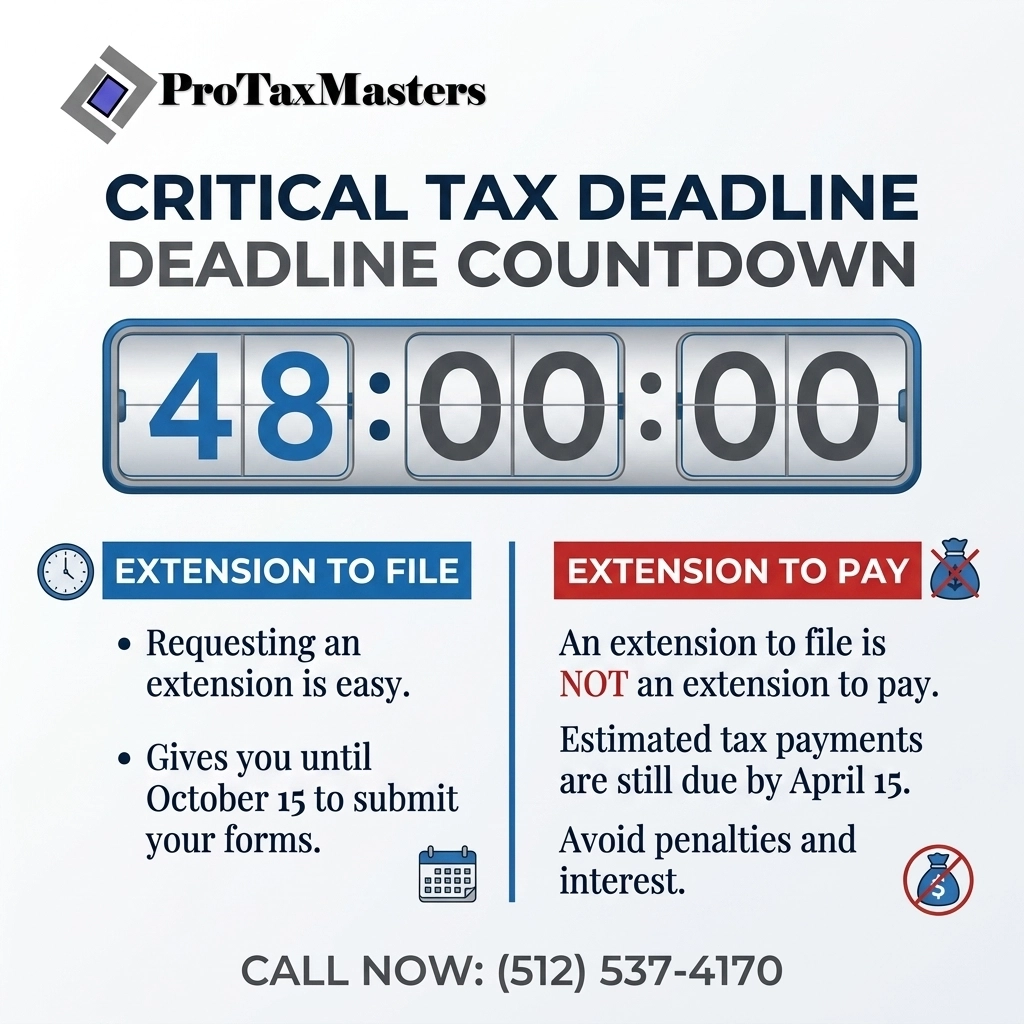
The single most important thing to understand before the April 15th deadline is this: An extension to file is NOT an extension to pay.
Many taxpayers believe that by filing Form 4868 (Application for Automatic Extension of Time to File U.S. Individual Income Tax Return), they are buying themselves six extra months to settle their bill with the IRS. This is a dangerous misconception that can lead to unexpected penalties and interest.
The Deadlines You Need to Know:
- Individual Income Tax Returns (1040): Due Tuesday, April 15, 2026.
- C-Corporation Returns (1120): Due Tuesday, April 15, 2026.
- S-Corporations (1120-S) and Partnerships (1065): These deadlines passed on March 16, 2026. If you missed these, we need to talk immediately to mitigate late-filing penalties.
When you file an extension, you move your filing deadline to October 15, 2026. However, the IRS expects 100% of the tax you owe to be paid by April 15. If you think you will owe money, you must estimate that amount and send it in now.
2. The High Cost of Inaction: Penalty Math
If you are debating whether to file now or wait, let the math help you decide. The IRS distinguishes between "Failure to File" and "Failure to Pay," and one is much more expensive than the other.
- Failure to File Penalty: This is generally 5% of the unpaid taxes for each month or part of a month that a tax return is late. It caps at 25%.
- Failure to Pay Penalty: This is 0.5% of the unpaid taxes for each month or part of a month the tax remains unpaid. It also caps at 25%.
Notice the difference? The penalty for not filing is 10 times higher than the penalty for not paying.
Our advice: Even if you cannot pay a single dime of what you owe, you must still file your return or an extension by Tuesday. Filing an extension stops the 5% monthly clock, even if the 0.5% clock continues to tick.
3. What to Do with "Wrong" Information or Missing Forms
We often see clients freeze up because they received a 1099-NEC or 1099-MISC with incorrect amounts, and the issuer hasn't sent a corrected version yet. With only four days left, you don't have time to wait for a bureaucratic correction.
The ProTaxMasters Strategy
If you have a form with wrong information, we recommend filing the return using the reported amount or the amount you know to be correct. The key difference when working with a professional firm like ProTaxMasters is our ability to use professional-grade software.
Most DIY consumer software packages don't allow you to easily attach explanatory statements to your return. As professionals, we can include a formal statement with your filing that explains the discrepancy. This tells the IRS: "We are reporting what we know to be true, and here is why it differs from the form provided."
This proactive transparency is often the difference between a smooth processing and a red flag for an audit.
4. Your 48-Hour Action Plan
Don't spend the next two days in a "analysis paralysis" loop. Follow these steps to secure your peace of mind:
- Gather Everything You Have: Collect all W-2s, 1099s, and expense receipts. If you are missing one or two items, proceed with what you have.
- Estimate Your Liability: If you haven't finished your return, look at last year's tax and your current income to estimate if you will owe.
- Pay What You Can: Even if you can't pay the full amount, pay as much as possible by April 15. This reduces the base amount upon which the 0.5% penalty and interest are calculated.
- File the Extension if Necessary: If you are missing documents, file Form 4868 by Tuesday night.
- Seek Expert Tax Preparation Help: Don't go it alone in the final hours. Expert help ensures that your "best guess" is an educated one that minimizes your legal risk.

5. Why Peace of Mind Matters
Tax season shouldn't be a source of dread. At ProTaxMasters, we believe that accuracy and timely filing are the foundations of financial freedom. Whether you are a small business owner, a freelancer, or an individual with a complex portfolio, having a professional team in your corner means you don't have to worry about whether you "did it right."
We specialize in navigating the complexities of the tax code so you can focus on running your business and living your life. We are a Faith-Based Business, and we treat every return with the integrity and precision it deserves.
How We Help You Win:
- Maximum Legal Deductions: We find the savings you might miss in a rush.
- Accuracy: Professional software and expert review mean fewer errors.
- Compliance: We ensure you meet all IRS and FinCEN requirements.
6. Take Action Before the Clock Strikes Midnight
The next four days will move fast. If you are feeling overwhelmed, the best thing you can do is reach out. Let us help you determine if an extension is the right move for your specific situation or if we can push through and get your return filed accurately before Tuesday.
Contact ProTaxMasters Today:
- Email: team@protaxmasters.com
- Phone: (512) 537-4170
- Website: protaxmasters.com
Don't wait until Tuesday afternoon. Secure your peace of mind now.
Official Legal Disclaimer
IRS Circular 230 Disclosure: To ensure compliance with requirements imposed by the IRS, we inform you that any U.S. federal tax advice contained in this communication (including any attachments) is not intended or written to be used, and cannot be used, for the purpose of (i) avoiding penalties under the Internal Revenue Code or (ii) promoting, marketing or recommending to another party any transaction or matter addressed herein.
FinCEN BOI: Please be aware that, under FinCEN’s March 2025 interim final rule implementing the Corporate Transparency Act, domestic (U.S.) entities are now generally exempt from Beneficial Ownership Information (BOI) reporting. For the 2026 tax year, BOI filing requirements generally apply primarily to certain foreign entities that are registered to do business in the United States. ProTaxMasters can help you review whether your entity still has a filing obligation and what steps may be needed for compliance.
Bonus Depreciation: Tax laws regarding bonus depreciation have changed for the 2024-2026 tax years. For property placed in service in 2025/2026, the bonus depreciation percentage may be reduced. Please consult with our professionals to understand how these phase-outs affect your specific business assets and tax strategy.
No Professional-Client Relationship: The information provided in this blog post is for general informational purposes only and does not constitute professional tax, legal, or financial advice. Accessing or reading this post does not create a professional-client relationship between you and ProTaxMasters. You should consult with a qualified professional regarding your specific tax situation before taking any action.