Managing Quarterly Taxes for Self Employed: Is Your Hobby Actually a Business?
In the current economic climate of 2026, the "side hustle" has evolved from a trend into a financial necessity for many. Whether you are selling handcrafted goods on digital marketplaces, driving for a rideshare platform, or providing freelance consulting services, managing quarterly taxes for self employed workers starts with understanding how the IRS classifies your activity. The way you classify your work can have massive implications on your tax bill.
At ProTaxMasters, we frequently see clients who are unsure whether their weekend passion project is a "hobby" or a "business" in the eyes of the Internal Revenue Service (IRS).
While the distinction might seem academic, it is one of the most critical factors in determining your tax liability. Misclassifying your activity, or failing to understand the rules for the 2026 tax year, could result in lost deductions, back taxes, and significant penalties.

Why the Distinction Matters in 2026
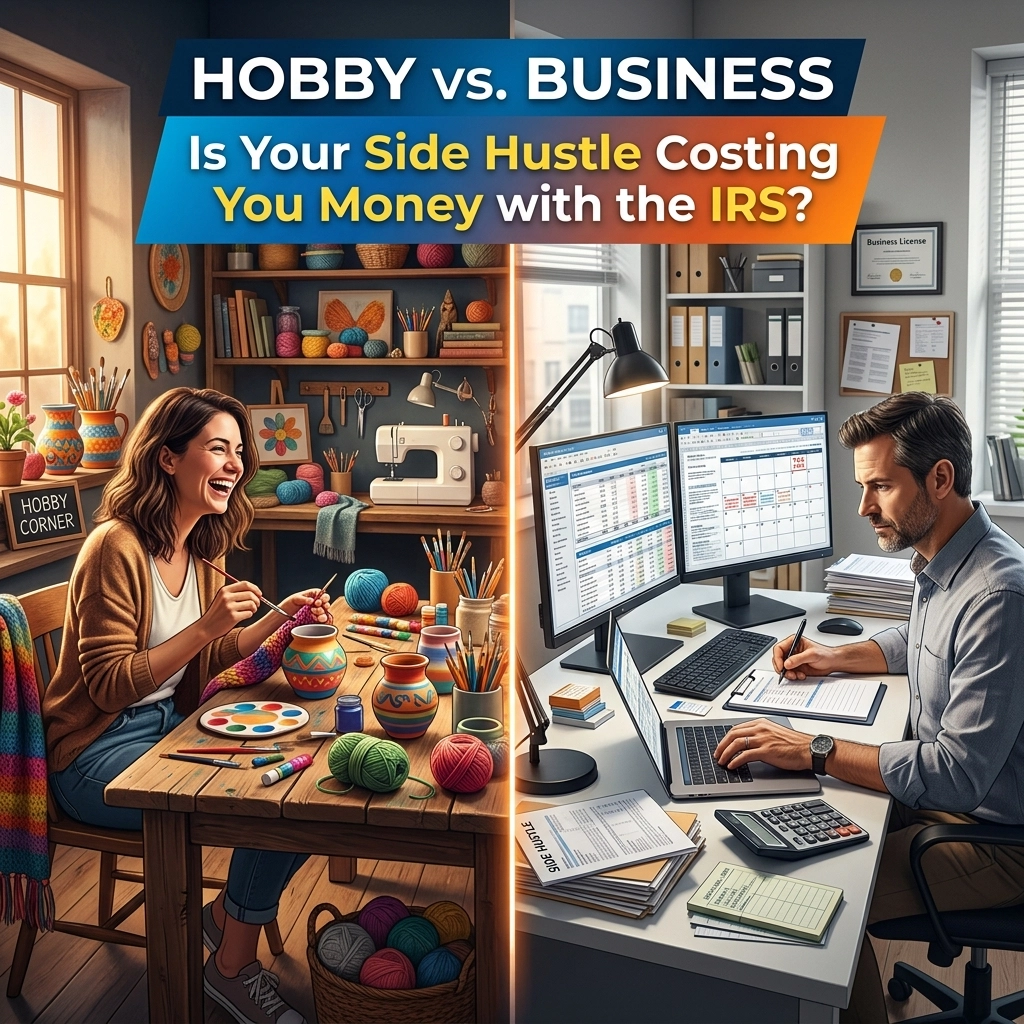
The IRS views businesses and hobbies through two completely different lenses. The primary driver behind this distinction is the "profit motive."
The Business Tax Advantage
If your activity is classified as a business, you report your income and expenses on Schedule C (Form 1040). While you are required to pay self-employment tax (currently 15.3% on net earnings over $400) to cover Social Security and Medicare, you are also allowed to deduct all "ordinary and necessary" business expenses. This includes everything from marketing and software subscriptions to a portion of your home utilities if you maintain a home office. These deductions reduce your taxable income, potentially lowering your overall tax bracket.
The Hobby Tax Trap
If the IRS deems your activity a hobby, the tax treatment is far less favorable. Under the rules extended through the mid-2020s, you must report 100% of the income generated from a hobby as "Other Income" on Schedule 1 of your Form 1040. However, you generally cannot deduct any expenses associated with that hobby.
For example, if you sell $5,000 worth of photography prints as a hobby but spent $4,500 on equipment and travel, you are taxed on the full $5,000. If that same activity was a business, you would only be taxed on the $500 profit. This is why understanding the "Nine-Factor Test" is essential for your financial health.

The IRS "Nine-Factor Test" Explained
The IRS does not use a single "gotcha" metric to determine if you are running a business. Instead, they look at the "facts and circumstances" of your operation using a subjective nine-factor test. If you are audited, the IRS will evaluate the following:
1. The Manner in Which You Carry on the Activity
Do you treat your side hustle like a professional operation? This includes keeping a separate business bank account, maintaining accurate books and records, and having a formal business plan. If your personal and business finances are co-mingled, the IRS is more likely to view it as a hobby.
2. Your Expertise or That of Your Advisors
Do you have the knowledge necessary to carry out the activity profitably? If you don’t, have you sought advice from experts like the team at ProTaxMasters? Moving from a hobby to a business often requires professional consultation to ensure you are following industry standards.
3. The Time and Effort Expended
If you spend 30 hours a week on an activity, it strongly suggests a profit motive. If you only attend to it when you "feel like it" or for a few hours a month, it leans toward hobby status.
4. The Expectation That Assets May Appreciate in Value
In some cases, you may not make an operating profit, but the assets you use (such as real estate or specialized machinery) are expected to grow in value. The IRS considers this expectation of future gain as evidence of a business motive.
5. Your Success in Other Activities
If you have successfully turned other side ventures into profitable businesses in the past, the IRS is more likely to give you the benefit of the doubt on a new venture that is currently showing a loss.
6. The History of Income or Loss
While the "3-out-of-5-years" rule (making a profit in three of the last five years) is a common benchmark, it isn't an absolute law. However, consistent losses year after year without any change in strategy will signal to the IRS that you aren't truly trying to make money.
7. The Amount of Occasional Profits
Even if you don't make a profit every year, the size of the profits you do make matters. A massive windfall in one year can sometimes offset several years of small losses in the eyes of the IRS.
8. Your Financial Status
Do you depend on the income from this activity for your livelihood? If you have a high-paying full-time job and your "business" consistently loses money that offsets your high salary, the IRS will scrutinize it heavily as a potential tax shelter.
9. Elements of Personal Pleasure or Recreation
This is the most subjective factor. If the activity is something people typically do for fun (like breeding dogs, racing cars, or crafting), the burden of proof is higher to show it is a legitimate business.
Quarterly Taxes for Self Employed: Technical Deadlines and Filing Requirements for 2026
As we navigate the 2026 tax season, small business owners must stay vigilant about filing deadlines. Missing these dates can lead to heavy penalties, even if you are eventually classified as a business.
- March 16, 2026: Deadline for S-Corporation (Form 1120-S) and Partnership (Form 1065) tax returns. Because March 15 falls on a Sunday in 2026, the deadline moves to the next business day.
- April 15, 2026: Deadline for Individual Tax Returns (Form 1040), C-Corporations (Form 1120), and paying any taxes owed for the 2025 tax year.
- Quarterly Estimated Payments: If you expect to owe more than $1,000 in taxes, you must make payments on April 15, June 15, September 15, and January 15.

The New "OBBA" and BOI Reporting Context
Since the implementation of the Corporate Transparency Act (often discussed alongside broader regulatory shifts in the 2020s), most small businesses, including many side hustles that have incorporated as LLCs, are now required to file Beneficial Ownership Information (BOI) reports with FinCEN.
If you have moved your hobby into a formal LLC structure to protect your assets and claim business status, you must ensure your BOI filing is up to date. Failure to report can result in civil penalties of up to $500 per day. At ProTaxMasters, we assist our clients in navigating these new transparency requirements to ensure they remain compliant while maximizing their tax benefits.
Tips for Rideshare and Gig Economy Workers
If you are a driver for Uber, Lyft, or a delivery service, the IRS almost always considers you a business owner (independent contractor). You are not a "hobby" driver.
- Track Every Mile: In 2026, the standard mileage rate remains a powerful tool, but you must keep a contemporary log.
- 1099-K Thresholds: Be aware that third-party payment processors are now reporting much lower thresholds of income to the IRS. You will likely receive a 1099-K even for relatively small amounts of side income.
- The "Hobby" Risk: If you drive only occasionally and your expenses (gas, maintenance, depreciation) exceed your earnings every year, you run the risk of the IRS reclassifying you as a hobbyist and denying your loss deductions.
How to Protect Your Business Status
If you want to ensure your side hustle is treated as a business and keep those valuable deductions, take these steps today:
- Incorporate or Form an LLC: Creating a formal legal entity shows intent.
- Open a Business Account: Never pay for business supplies with a personal credit card.
- Maintain a Ledger: Use accounting software to track every dollar.
- Market Your Services: Keep records of advertisements, business cards, or your professional website.
- Consult a Professional: Work with an expert who understands the nuances of the 2026 tax code.

Final Thoughts
The line between a hobby and a business is thinner than most people realize. In 2026, with the IRS increasing its scrutiny of the gig economy and digital assets, you cannot afford to guess. Whether you are aiming to maximize your deductions or simply want to stay out of the IRS's crosshairs, ProTaxMasters is here to help you navigate the complexities of tax law.
Are you ready to take your side hustle to the next level?
Visit ProTaxMasters today to schedule a consultation and ensure your business is set up for success.
Legal Disclaimer:
Under IRS Circular 230, any tax advice contained in this communication is not intended to be used, and cannot be used, for the purpose of avoiding penalties. The information provided in this article is for educational purposes only and does not constitute professional tax, legal, or financial advice. ProTaxMasters does not establish a professional-client relationship through this content. Regarding FinCEN Beneficial Ownership Information (BOI) reporting, requirements may vary; please consult a qualified professional. Bonus depreciation rules are subject to change and should be reviewed on an individual basis. No Professional-Client Relationship is created by the viewing or distribution of this blog post.