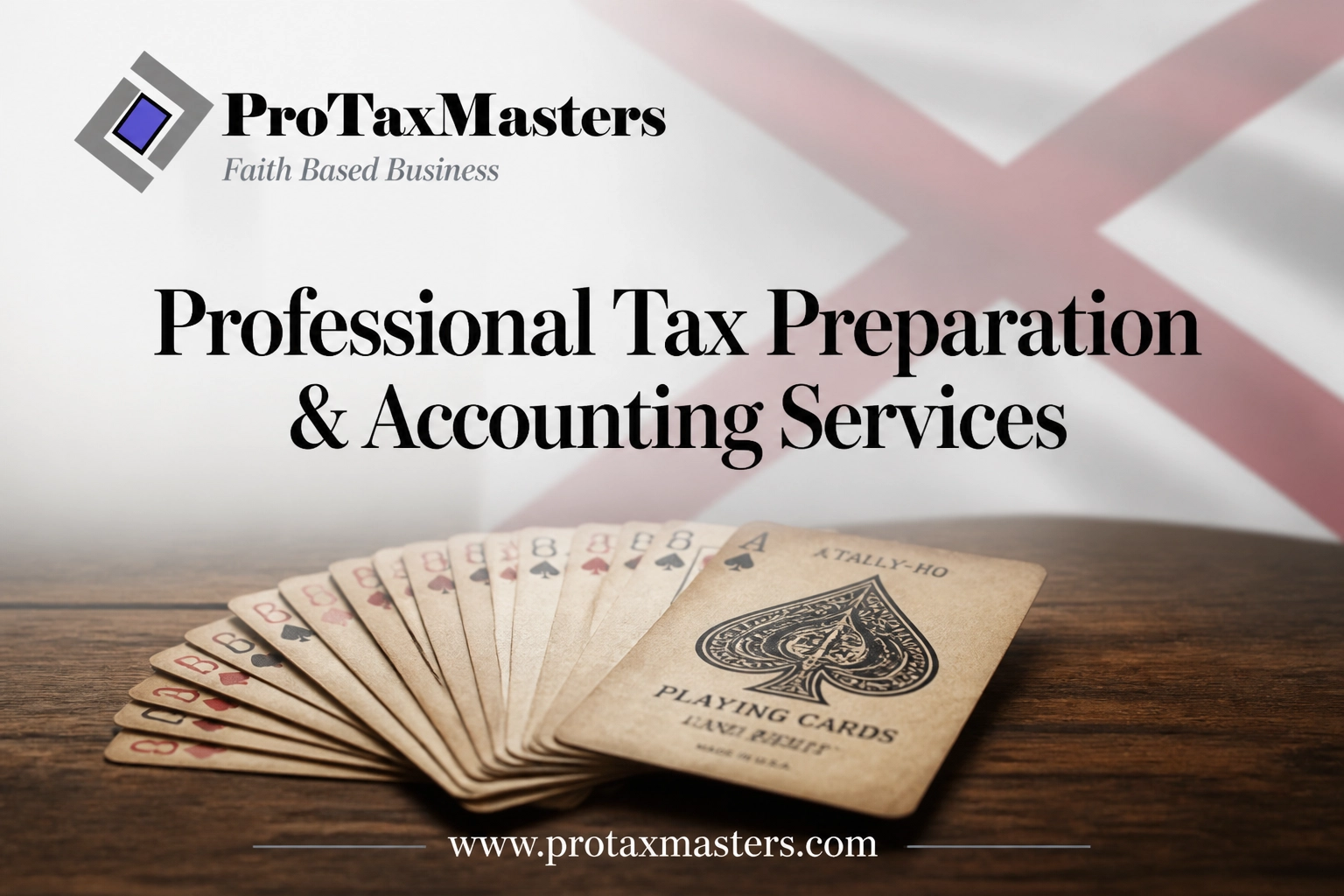
Alabama’s Playing Card Tax: Why a Deck of Cards Costs More in the South
If you’ve been following our "History Friday" series, you know we love a good deep dive into the strange origins of our modern financial world. We’ve covered everything from the Beard Tax of Peter the Great to the tax disputes that fueled the American Revolution. But as we wrap up our historical journey, we wanted to pivot into something a little more local and a lot more peculiar: Odd State Taxes.
Across the United States, tax codes aren't just about income and property. Sometimes, they’re about the small, everyday items you’d never expect. To kick off this new series, we’re heading down South to look at a law that, for 80 years, made a simple Saturday night poker game in Alabama just a little bit more expensive.
Welcome to the weird, wonderful world of the Alabama Playing Card Tax.
The Secret History of the Alabama Playing Card Tax
Back in 1935, the world was a very different place. The United States was in the middle of the Great Depression, and state governments were scrambling to find any way possible to keep their lights on. Revenue was down, and "sin taxes", taxes on items considered luxuries or moral vices, were all the rage.
Alabama looked at the humble deck of cards and saw an opportunity. For many, playing cards was a cheap form of entertainment during hard times, but for the state, it was a "privilege" that could be taxed. They established a tax of 10 cents per deck, a law that would eventually be codified in Section 40-12-144 of the Code of Alabama.

At first glance, 10 cents doesn't sound like much. But in 1935, a dime had the purchasing power of about $2.25 today! Imagine walking into a store and seeing a 20% or 30% tax added on top of a simple deck of cards. It was a bold move that stuck around much longer than anyone anticipated.
The Nitty-Gritty: Section 40-12-144
This wasn't just a general suggestion; it was a strictly regulated tax. Here’s how the law actually worked for decades:
- The Stamp Rule: Every single package of playing cards sold in Alabama had to have a 10-cent tax stamp affixed to it. If you were a retailer selling cards without that stamp, you were in hot water.
- The "54-Card" Limit: This is where it gets truly trivia-worthy. The law specifically applied to decks containing not more than 54 cards. This created a hilarious loophole: games like UNO, which typically have 108 cards, were exempt. If you wanted to play a game with a massive deck of specialized cards, you were tax-free. But if you wanted a standard 52-card deck for Bridge or Gin Rummy? The state wanted its dime.
- The Retailer License: Selling cards wasn’t just about the stamps. Retailers also had to pay a $2 annual license fee just for the "privilege" of having those decks on their shelves.
For the small business owners we work with at ProTaxMasters, this sounds like an administrative nightmare, and it was. Keeping track of specific stamps for one low-cost item is exactly the kind of "red tape" we help our clients cut through every day.
Why Do States Have "Odd" Taxes Anyway?
You might be wondering: Why bother? Why does Alabama tax playing cards, while Maine taxes blueberries and Hawaii offers tax breaks for exceptional trees?

There are actually three main reasons states lean into these quirky laws:
1. Targeted Consumption
As economists often point out, it is much easier for wealthy individuals to find legal ways to minimize their income tax. However, it is much harder to avoid a consumption tax. In the early 20th century, taxing items like playing cards, hats, or specialized services was a way for states to capture revenue from people who clearly had "disposable income" to spend on entertainment.
2. Protecting and Promoting Local Industries
Some "weird" taxes are actually designed to help. For example, Maine’s blueberry tax (which we’ll cover later in this series!) is used to fund research and promotion for the state's blueberry industry. It’s essentially the industry's way of taxing itself to pay for marketing.
3. Behavioral Incentives
Taxes are one of the most powerful tools a government has to discourage or encourage behavior. "Sin taxes" on tobacco or alcohol are designed to make the habit more expensive. On the flip side, Hawaii’s "Exceptional Tree" deduction encourages property owners to maintain the island's natural beauty by giving them a tax break for professional tree care.
The End of the Stamp: Why Alabama Quit in 2015
If you go to a gas station in Birmingham today, you won’t see a tax stamp on your deck of cards. So, what changed?
By 2014, the Alabama Department of Revenue realized they had a problem. The playing card tax was generating roughly $100,000 over a five-year period. While that sounds like a lot of money, you have to consider the "Cost of Collection."
Between printing the stamps, auditing the retailers, and processing the $2 license fees, the state was spending almost as much money (and man-hours) to collect the tax as the tax was actually bringing in.
In a win for common sense, the state legislature passed Act 2014-331, which gave the Department of Revenue the authority to suspend taxes where the administrative costs exceeded the revenue. On May 1, 2015, the playing card tax was officially suspended.
What’s Next in the 'Odd State Taxes' Series?
Alabama’s playing card tax is just the tip of the iceberg. Over the next few weeks, we’re going to dive into more "oddities" that might affect your business or your travel plans:
- The Maine Blueberry Tax: How 1.5 cents per pound keeps an entire industry afloat.
- Hawaii’s Tree Deduction: Why your backyard foliage might be worth a write-off.
- The "Jock Tax": Why professional athletes have to file tax returns in almost every state they play in (and how this affects traveling consultants, too!).
ProTaxMasters: Making Sense of the Complex
Whether it’s a 10-cent stamp on a deck of cards or the complex filing requirements for an S-Corp (don’t forget, S-Corp and Partnership returns are generally due March 15th, while individual and C-Corp returns are due April 15th!), taxes can be a headache.
At ProTaxMasters, we believe you shouldn't have to be a historian or a legal scholar to stay compliant. Our goal is to provide you with peace of mind by handling the technical details so you can focus on growing your business. From maximizing legal deductions to ensuring timely filings, we’ve got your back.

Ready to stop gambling with your taxes?
Don't let quirky laws or complex codes hold you back. Whether you're a freelancer navigating the self-employment tax or a small business owner looking for a reliable partner in financial management, we are here to help.
Click here to book your consultation with ProTaxMasters today!
Official Legal Disclaimer
IRS Circular 230 Disclosure: To ensure compliance with requirements imposed by the IRS, we inform you that any U.S. federal tax advice contained in this communication (including any attachments) is not intended or written to be used, and cannot be used, for the purpose of (i) avoiding penalties under the Internal Revenue Code or (ii) promoting, marketing or recommending to another party any transaction or matter addressed herein.
FinCEN BOI: Small businesses should be aware of the Beneficial Ownership Information (BOI) reporting requirements effective January 1, 2024, under the Corporate Transparency Act. Failure to comply may result in significant civil and criminal penalties.
Bonus Depreciation: Please note that under current tax law, bonus depreciation percentages are subject to a phase-down schedule. For the 2024 tax year, the rate is 60%, and it will continue to decrease by 20% annually unless legislative changes are enacted.
No Professional-Client Relationship: The information provided in this blog post is for general informational purposes only and does not constitute professional tax, legal, or financial advice. Accessing or consuming this content does not create a professional-client relationship between the reader and ProTaxMasters. Always consult with a qualified tax professional regarding your specific situation.