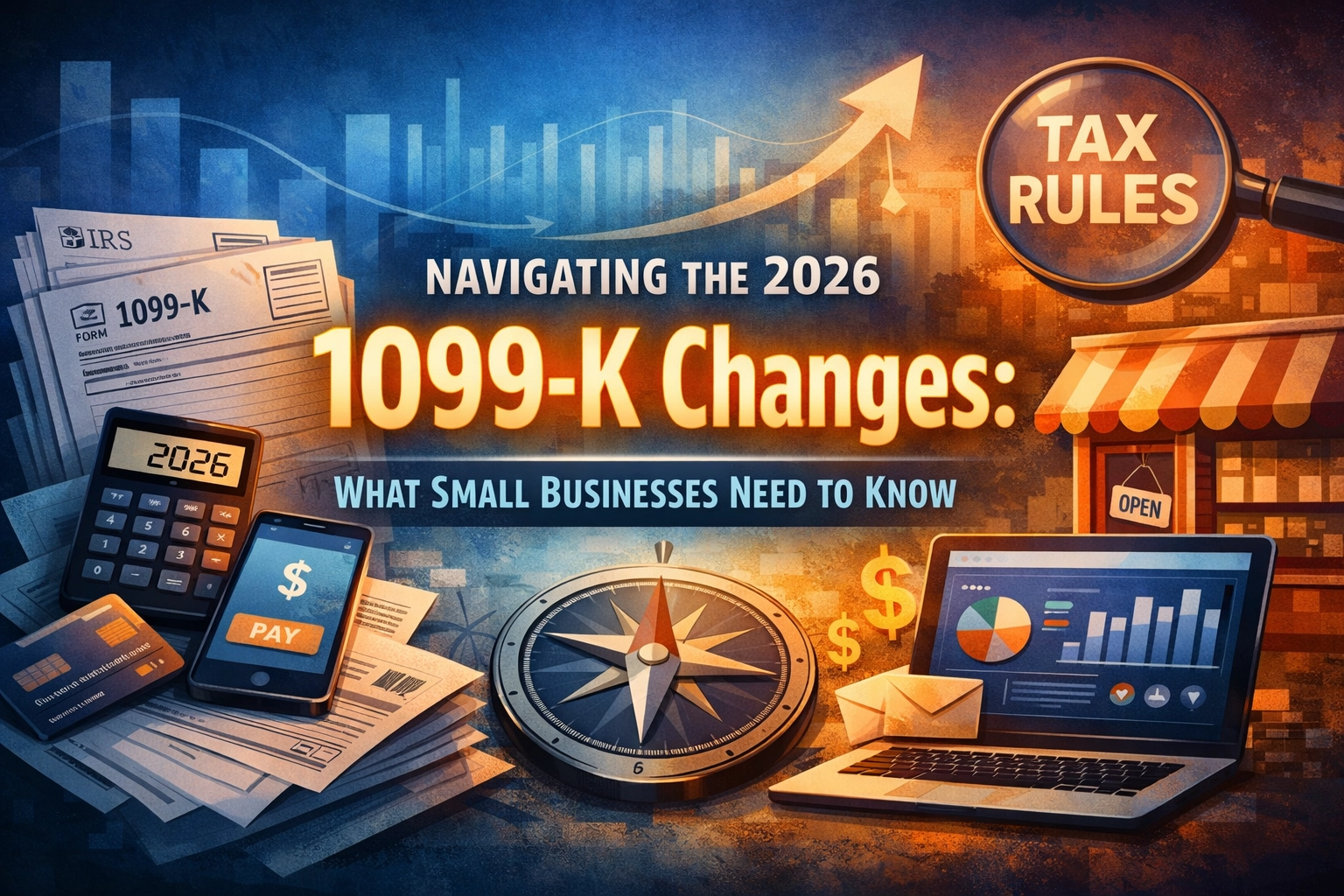
Navigating the 2026 1099-K Changes: What Small Businesses Need to Know
For the past few years, small business owners and side-hustlers have been holding their breath every time the IRS mentioned the Form 1099-K. We’ve seen proposed changes, delays, and a whole lot of confusion regarding how much you can receive through apps like Venmo, PayPal, and Stripe before the government wants a formal report.
As we move through 2026, the dust has finally settled, at least for now. At ProTaxMasters, we want to make sure you aren't caught off guard by the latest reporting requirements. Whether you’re a San Marcos marketplace seller, a local artisan taking custom orders, or a growing service business that gets paid through card processors, staying informed is the best way to avoid a surprise letter from the IRS.
Professional Disclaimer
This article is for informational purposes only and is not intended as tax, legal, or accounting advice. Tax laws and regulations—including 1099 thresholds and BOI reporting requirements—are subject to frequent change. As of March 26, 2025, all entities created in the United States (domestic companies) and their beneficial owners are exempt from the requirement to report beneficial ownership information (BOI) to FinCEN. Only foreign-formed companies that are registered to do business in the United States remain subject to BOI reporting requirements. For the most current details, visit fincen.gov/boi. This content is current as of the date of publication but may be superseded by new legislation, FinCEN guidance, or IRS guidance.
Reading this article does not create a professional-client relationship. Because every situation is unique, you should not rely on this information without consulting a qualified professional. For guidance tailored to your specific facts and circumstances, please contact ProTaxMasters.
The Big Reset: The $20,000 and 200 Transaction Threshold
If you were worried about the rumored $600 threshold for 1099-K reporting, you can breathe a sigh of relief. For tax year 2025 (the returns we are filing in early 2026), the IRS has officially restored the "old" thresholds.
Third-party settlement organizations (TPSOs) are only required to issue a Form 1099-K if you meet both of the following criteria:
- Gross payments exceed $20,000.
- The number of transactions exceeds 200.
This is a massive rollback from the previously planned $600 threshold that caused so much anxiety. Under those old (new) rules, nearly every casual seller would have received a form. Now, the administrative burden has shifted back toward larger-scale businesses.

Why the Change?
The IRS realized that moving to a $600 threshold would result in millions of forms being sent to people who weren't actually running businesses, like roommates splitting rent or friends paying each other back for dinner. To prevent a "tsunami of forms," the higher threshold remains in place for 2026 filings. However, don't get too comfortable; the IRS still has the authority to adjust these numbers in future years. You can stay updated on these shifts by checking our tax and bookkeeping insights.
The $2,000 Milestone: 1099-NEC and 1099-MISC Changes
While the 1099-K got most of the headlines, another significant change has hit for 2026 that affects how you pay your contractors. The threshold for filing Form 1099-NEC (Non-Employee Compensation) and Form 1099-MISC has increased from $600 to $2,000.
This is part of the broader effort to account for inflation and reduce the paperwork load for small business owners. If you hire a freelance graphic designer or a contract bookkeeper and pay them $1,500 over the course of the year, you are no longer required to issue them a 1099-NEC in 2026.
Important Note: Starting in 2027, this $2,000 threshold will be adjusted annually for inflation in $100 increments. This means the days of the static $600 rule are officially behind us.
Does "No Form" Mean "No Tax"?
This is the most dangerous misconception in the world of accounting. We all know how hard it can be to justify paying taxes on money that the IRS seemingly doesn't know about, but the law is very clear: All income is taxable regardless of whether or not you receive a 1099 form.
If your business brings in $15,000 through Stripe across 150 transactions, you won't get a 1099-K. However, that $15,000 is still gross revenue that must be reported on your Schedule C or your corporate tax return. The IRS uses "indirect methods" of auditing, meaning they can look at your bank deposits or lifestyle vs. reported income to find discrepancies.

Critical Deadlines for 2026
Mark these dates on your calendar. Missing these can lead to hefty penalties under Internal Revenue Code sections that govern timely filing.
- January 31, 2026: Deadline for businesses to send 1099-NEC and 1099-MISC forms to recipients.
- March 15, 2026: The big one for S-Corps and Partnerships. If your business is structured as an entity, this is your deadline for filing Form 1120-S or 1065.
- April 15, 2026: The deadline for individual returns (Form 1040), C-Corps (Form 1120), and making your first estimated tax payment for the 2026 tax year.
If you are feeling overwhelmed by these dates, check out your quick-start guide to tax preparation services to get ahead of the rush.
Technical Deep Dive: IRC Section 6050W
For those who like to know the "why" behind the "what," the 1099-K is governed by Internal Revenue Code Section 6050W. This section was originally added to the code to increase tax compliance among small businesses that deal primarily in cash or electronic payments.
The 2026 status quo is essentially a result of the IRS exercising "administrative transition relief." While the law technically still points toward lower thresholds, the IRS has used its discretion to keep the $20k/200-transaction rule active to avoid taxpayer confusion. As experts in accounting and tax services, we monitor these administrative notices weekly to ensure our clients are always in compliance.

3 Best Practices for 1099-K Compliance in 2026
Even with the higher thresholds, you should treat your business finances with a high level of scrutiny. Here is how you should handle your electronic payments:
- Separate Personal from Business: Never, ever use a personal Venmo or PayPal account for business transactions. Use "Business Profiles." This ensures that when 1099-Ks are generated, they don't include that $50 your mom sent you for her share of the family phone bill.
- Reconcile Monthly: Don't wait until February 2027 to look at your 2026 numbers. Compare your bank statements to your Stripe/PayPal dashboards monthly. If a 1099-K is eventually issued and it’s wrong, it is much easier to fix in July than in April.
- Document Non-Taxable Income: If you receive a refund or a reimbursement through a payment processor, tag it immediately in your bookkeeping software. If you do get a 1099-K that includes these amounts, you’ll need documentation to "back out" those non-taxable numbers so you don't pay tax on money that isn't profit.
How ProTaxMasters Can Help
Navigating the transition from the $600 panic back to the $20,000 reality requires a steady hand. Whether you are wondering if you need to issue forms to your contractors or you need help reconciling your payment processor accounts, we are here to simplify the process.
We offer transparent pricing for 2026 so you can get the professional help you need without breaking the bank. We all know how hard it can be to balance the books while growing a brand, which is why we focus on taking the tax burden off your plate entirely.
Next Steps for You:
- Review your 2025 totals: Did you cross the $20,000 and 200 transaction mark? If so, look for a 1099-K in your email or physical mail.
- Audit your contractor list: Did you pay anyone more than $2,000? You’ll need to issue them a 1099-NEC.
- Schedule a consultation: If your books are a mess, don't wait until the March 15th or April 15th deadlines.
Visit our blog category for more tax tips or reach out to us directly through our homepage to get started. Let’s make 2026 the year your business finances finally feel organized and stress-free.