Business Tax Filing: New 1099 Rules and Tax Deductions for Freelancers
If you’ve handled business tax filing for a while, you probably know the old $600 1099 rule by heart. That rule has now changed, and the update matters for both small businesses and anyone tracking tax deductions for freelancers.
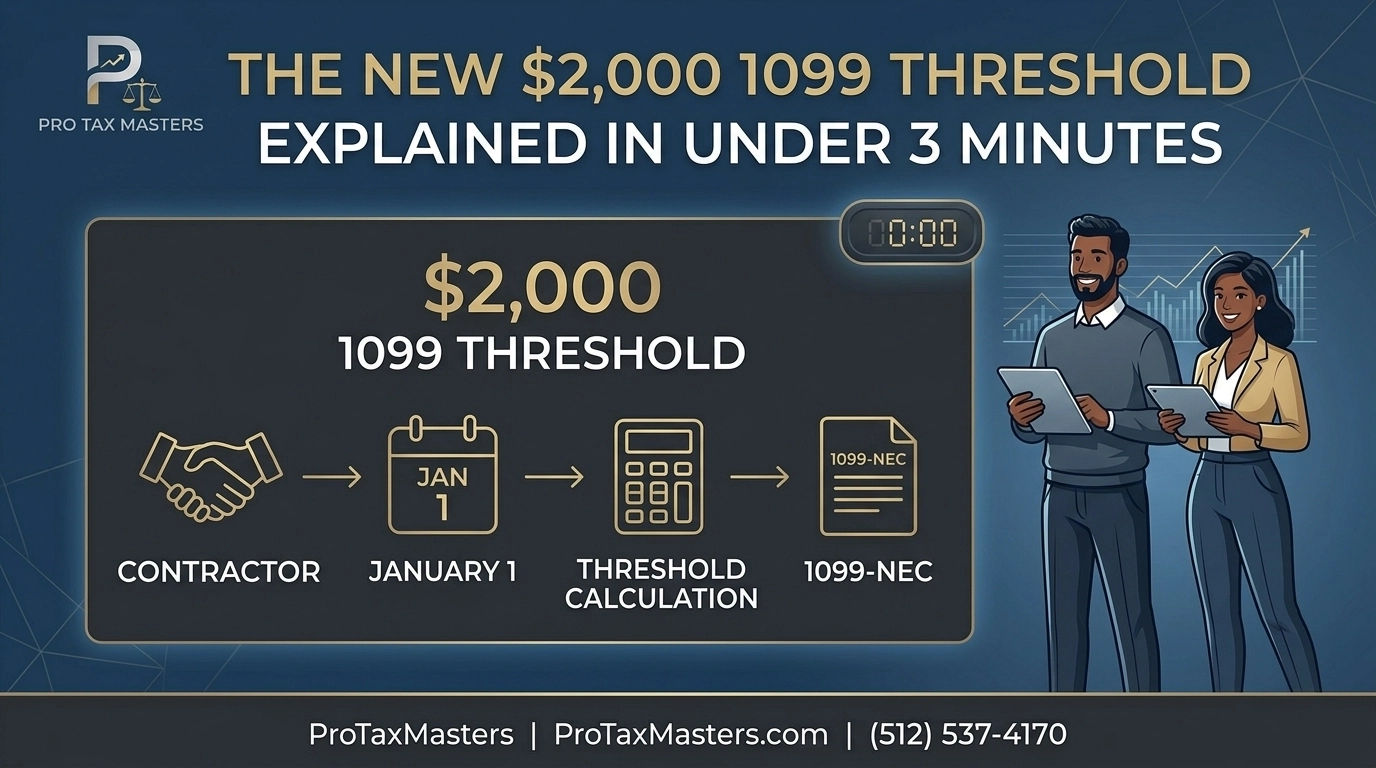
Effective January 1, 2026, the One Big Beautiful Bill Act raised the 1099-NEC and 1099-MISC reporting threshold to $2,000. That means less paperwork, but not less responsibility. Accurate records, smart business tax filing, and proper deduction tracking still matter.
At ProTaxMasters, we help business owners and self-employed professionals stay compliant, file on time, and avoid expensive mistakes during deadline season.
Quick Business Tax Filing Summary
If you only have a minute, here is what matters most:
- 1099-NEC & 1099-MISC: The filing threshold increased from $600 to $2,000.
- 1099-K: The proposed $600 app-payment rule was scrapped. The threshold stays at $20,000 and 200+ transactions.
- Freelancer income is still taxable: Even if no 1099 is issued, freelancers must still report all income.
- Tax deductions for freelancers still count: Home office, mileage, software, supplies, and professional fees may still be deductible if properly documented.

Business Tax Filing and the $2,000 Reporting Limit
The jump to $2,000 for Form 1099-NEC and Form 1099-MISC is a major shift for business tax filing.
It reduces reporting volume, but it does not change the taxability of income. If you pay a freelancer $1,500, that income is still taxable to them even if no 1099 is issued.
What This Means for Businesses
- Less paperwork: Fewer low-dollar 1099 forms to prepare.
- Same recordkeeping rules: You still need clean books and vendor payment tracking.
- Same best practice: Collect a Form W-9 before paying contractors.
- Same key deadline: The deadline for 1099-NEC remains January 31st.
Tax Deductions for Freelancers Still Matter
For freelancers, this rule change does not reduce the value of legitimate write-offs. Common tax deductions for freelancers may include:
- Home office expenses
- Business mileage and vehicle use
- Software and subscriptions
- Advertising and marketing
- Office supplies and equipment
- Professional services such as bookkeeping or tax prep
The bottom line: no 1099 does not mean no income, and deductible expenses still need documentation.
The 1099-K Rule Stayed More Manageable
The feared $600 Form 1099-K rule for third-party payment apps did not move forward.
For 2026, the threshold remains:
- More than $20,000 in payments
- More than 200 transactions
That is helpful for business tax filing, but freelancers should still track every dollar earned through Stripe, PayPal, Venmo, and similar platforms. A missing form does not erase taxable income.

Deadline Push Checklist for Business Tax Filing
Use this quick checklist before filing deadlines hit:
- Review contractor totals: Identify vendors nearing or exceeding the $2,000 threshold.
- Collect W-9s: Make sure taxpayer information is on file before year-end.
- Track freelancer expenses: Separate deductible business expenses from personal spending.
- Prepare for e-filing: Businesses filing 10 or more information returns generally must file electronically.
- Use the right form: File 1099-NEC for contractor pay and 1099-MISC for other qualifying payments.
Key Filing Dates to Remember
Missing a deadline can lead to hefty penalties from the IRS. Mark your calendars for these essential 2026/2027 dates:
- January 31, 2027: Deadline to provide 1099-NEC and 1099-MISC forms to your recipients and the IRS.
- March 15, 2027: S-Corp (Form 1120-S) and Partnership (Form 1065) income tax returns are due.
- April 15, 2027: C-Corp (Form 1120) and Individual (Form 1040) returns are due.

Future-Proofing: The Inflation Adjustment
Starting in 2027, the $2,000 threshold will be adjusted annually for inflation and rounded to the nearest $100.
That should make future business tax filing updates more realistic and easier to manage than the old decades-long gap.
How ProTaxMasters Can Help
At ProTaxMasters, we help with business tax filing, 1099 compliance, bookkeeping cleanup, and tax deductions for freelancers.

If you are behind, rushed, or unsure what to file, now is the time to act.
Take Action Today:
- Review contractor payments and flag anyone over $2,000.
- Organize freelancer deductions with receipts, mileage logs, and software expenses.
- Contact ProTaxMasters for help filing accurately and on time.
Legal Disclaimer
IRS Circular 230 Disclosure: To ensure compliance with requirements imposed by the IRS, we inform you that any U.S. federal tax advice contained in this communication (including any attachments) is not intended or written to be used, and cannot be used, for the purpose of (i) avoiding penalties under the Internal Revenue Code or (ii) promoting, marketing, or recommending to another party any transaction or matter addressed herein.
FinCEN BOI Reporting: As of March 26, 2025, all entities created in the United States (domestic companies) and their beneficial owners are exempt from the requirement to report Beneficial Ownership Information (BOI) to FinCEN. Only foreign-formed companies that are registered to do business in the United States are still required to file. For current rules and filing details, visit fincen.gov/boi. ProTaxMasters provides general information but formal legal advice should be sought for specific filing requirements.
Bonus Depreciation: Taxpayers should be aware that bonus depreciation rates are subject to phase-out schedules under the Tax Cuts and Jobs Act (TCJA). For the 2026 tax year, please consult with a professional to determine the applicable percentage for qualifying property placed in service.
No Professional-Client Relationship: The information provided in this blog post is for general informational purposes only and does not constitute professional accounting, tax, or legal advice. Accessing or viewing this material does not create a professional-client relationship between the reader and ProTaxMasters. You should consult with a qualified professional regarding your specific situation before taking any action.