Texas Marketplace Fees and Sales Tax: A Proposed Change Small Businesses Should Watch
Texas businesses that sell products, deliver food, provide rides, rent property, or offer services through online platforms may want to watch an important sales-tax development coming from the Texas Comptroller.
On September 30, 2026, Texas Comptroller Don Huffines directed the agency to propose an amendment to Rule 3.330, Data Processing Services. The proposed change would remove certain marketplace and platform fees from the definition of taxable data processing services.
For small businesses that depend on online marketplaces and apps to reach customers, the change could eventually affect the Texas sales tax treatment of fees they pay to those platforms.
But there is an important distinction: the proposed rule is not final.
Businesses should understand what Texas is proposing without prematurely changing their tax treatment.
Why Texas Marketplace Fees Became a Sales Tax Issue
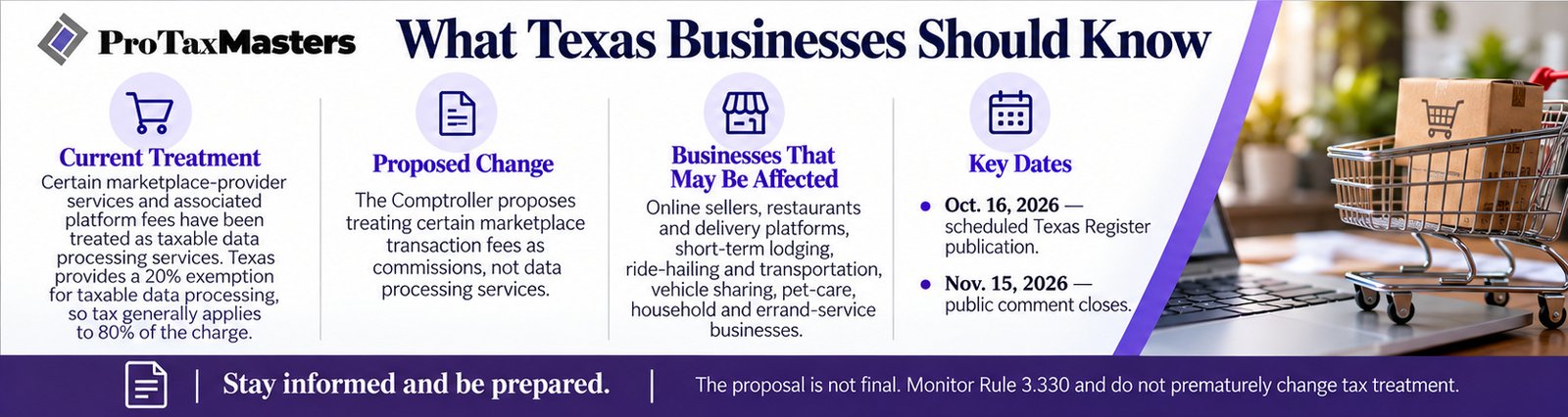
Texas imposes sales tax on certain taxable services, including data processing services. Texas currently provides a 20% exemption for charges for taxable data processing services, meaning tax generally applies to the remaining 80% of the charge.
In 2025, the Comptroller amended Rule 3.330 concerning data processing services. The agency subsequently treated certain marketplace-provider services and associated platform fees as taxable data processing services.
A Texas private letter ruling illustrates how this treatment can operate. In that ruling, a marketplace provider’s platform involved computerized retrieval, storage and manipulation of information. The Comptroller concluded that a platform fee constituted taxable data processing and that tax applied to 80% of the charge.
That treatment became controversial among businesses that use online platforms.
What the Texas Comptroller Is Proposing
On September 30, the Comptroller issued Executive Order DH-2026-01 directing the agency to propose an amendment to Rule 3.330.
The Comptroller’s current proposed-rule summary explains that transaction fees charged by marketplace providers would be treated as commissions rather than data processing services.
The Comptroller identified a broad range of activities potentially affected, including businesses using marketplaces to sell products, food and grocery delivery platforms, short-term lodging platforms, ride-hailing and transportation services, vehicle sharing, pet-care services, and household or errand-service platforms.
That makes this development relevant well beyond traditional online retailers.
Marketplace Sales Tax and Platform Fees Are Different Issues
One distinction is particularly important.
The proposal concerns the tax treatment of marketplace or platform fees. It does not eliminate the existing Texas sales-tax responsibilities associated with taxable products and services sold through marketplaces.
Texas generally requires marketplace providers to collect and remit applicable Texas sales and use tax on taxable marketplace sales when the statutory requirements apply.
Marketplace sellers also continue to have reporting responsibilities. For example, the Comptroller instructs marketplace sellers to include marketplace sales in Total Texas Sales while generally excluding those sales from Taxable Sales when the marketplace has certified that it will collect and remit the tax. Sellers remain responsible for appropriate tax on sales they make outside the marketplace.
In other words, a potential change in the taxation of the platform’s fee should not be confused with the sales tax due on the underlying transaction.
Why This Matters to Texas Small Businesses
Platform fees can be a meaningful operating expense.
A restaurant may pay a delivery platform. An online retailer may pay marketplace commissions. A short-term rental operator may use an online booking platform. A contractor or service provider may depend on an app to obtain customers.
The Comptroller has stated that Texas business owners raised concerns that taxing these fees increased their costs and put some Texas sellers at a competitive disadvantage.
If the proposed amendment ultimately becomes final, businesses using affected platforms should review how those fees are invoiced and how Texas sales tax is being charged.
The Rulemaking Process Is Not Finished
This is where businesses should be careful.
The Comptroller’s proposed-rule page currently lists October 16, 2026 as the Texas Register publication date for the Rule 3.330 amendment. The public-comment period is scheduled to close November 15, 2026.
The Texas Register is the state’s official journal for agency rulemaking. Proposed rules can proceed through public comment before adoption, and the final provisions can differ from what was originally proposed.
Therefore, a September 30 announcement or executive order should not be treated as though the final tax rule is already in effect.
What Should Texas Businesses Do Now?
For most affected businesses, this is a time to monitor and document—not prematurely change tax treatment.
Businesses that pay marketplace or platform fees should consider identifying which platforms they use, retaining invoices showing fees and Texas sales tax separately, reviewing how the platform describes each charge, and watching the Rule 3.330 rulemaking process.
Once the final rule is adopted, businesses can determine whether their particular fees fall within the final language and whether any accounting or sales-tax procedures should change.
The tax treatment can depend on the actual service being provided rather than simply the name appearing on an invoice. Businesses with significant platform expenses or unusual arrangements may benefit from reviewing their particular facts with a tax professional.
A Texas Tax Issue Worth Watching
Technology has changed how Texas businesses find customers, process transactions and deliver services. Tax rules written for traditional business models do not always fit neatly into an economy built around online marketplaces and apps.
The proposed amendment to Rule 3.330 is therefore worth following—particularly for Texas restaurants, online sellers, gig-economy workers, short-term rental operators and other businesses paying recurring platform fees.
Texas has proposed changing the sales-tax treatment of certain marketplace and platform fees, but the rule is not yet final.
ProTaxMasters LLC will continue monitoring the rulemaking process as it moves through publication, public comment and eventual adoption.
If your Texas business has questions about sales tax, marketplace activity, or how a tax change may affect your operations, schedule a consultation with ProTaxMasters LLC.
This article provides general educational tax information and is not individualized tax or legal advice. Application of Texas sales and use tax depends on the facts and applicable law and administrative guidance.