
New Federal Scholarship Tax Credit for 2027: What Texas Families Should Know
The Texas federal scholarship tax credit for 2027 may create a new way for individuals to support K–12 educational scholarships while receiving a federal income tax credit. Texas has elected to participate, and the U.S. Department of the Treasury and the IRS released proposed regulations on October 1, 2026, explaining how the program is expected to operate.
The credit does not begin until 2027, and several important administrative steps remain. Taxpayers should not assume that a contribution made in 2026—or a contribution to any education-related charity—will qualify.
Here is what Texas families and potential donors should understand before making plans.
What Is the Federal Scholarship Tax Credit?
Congress created Internal Revenue Code Section 25F in 2025. It establishes a nonrefundable federal income tax credit for qualifying cash contributions to approved Scholarship Granting Organizations, commonly called SGOs.
An SGO is a qualifying charitable organization that uses contributed funds to provide scholarships for eligible elementary and secondary education expenses. The program is scheduled to apply to tax years ending after December 31, 2026, so qualifying contributions generally begin in 2027.
This is a tax credit rather than a deduction. A credit reduces federal income tax dollar for dollar, subject to the taxpayer’s available tax liability and the program’s limits.
Texas Has Elected to Participate
Participation is voluntary for each state. According to the IRS, Texas has made an advance election to participate for 2027.
That election is an important first step, but it is not the end of the process. Participating states must identify qualifying SGOs, and the IRS will maintain the official list taxpayers should consult before contributing.
Under the proposed regulations, a taxpayer could contribute to an approved SGO in any participating state, regardless of where the taxpayer lives. The key requirement is that the organization appear on the IRS SGO list at the time of the contribution.
How Much Could the Credit Be?
The enacted law generally limits the credit to $1,700 per individual taxpayer each year.
The proposed regulations interpret that limitation separately for each spouse filing a joint return. Under that interpretation, a married couple filing jointly could potentially claim up to $3,400, provided each spouse makes qualifying contributions of up to $1,700.
Because this joint-return treatment appears in proposed regulations, taxpayers should watch for final guidance before relying on it.
The credit is nonrefundable. It generally cannot reduce federal income tax below zero. However, the proposed regulations provide that an unused credit may be carried forward for up to five years.
What Contributions Are Expected to Qualify?
The proposed framework generally requires:
- A cash contribution made during 2027 or a later qualifying year;
- A contribution to an organization appearing on the IRS’s official SGO list when the contribution is made;
- A designation that the contribution is intended to be a qualified Section 25F contribution; and
- A timely written acknowledgment from the SGO containing the required information, including a unique donor number.
Taxpayers should retain the acknowledgment with their tax records. The proposed regulations anticipate that the credit will be claimed on Form 8525, Federal Scholarship Tax Credit, or a successor form.
Contributions made during 2026 do not become eligible merely because the organization later qualifies for the program. Timing and the organization’s status at the time of contribution matter.
The Credit and the Charitable Deduction Are Not the Same Benefit
A contribution used to claim the federal scholarship tax credit cannot also be claimed as a federal charitable contribution deduction. This prevents a double federal tax benefit for the same amount.
The proposed rules also coordinate the federal credit with any state tax credit connected to the same contribution. A state credit may reduce the amount available for the federal credit, although the proposed calculation is intended to preserve the maximum federal credit permitted after that adjustment.
Texas does not impose an individual income tax, but this coordination rule may still matter to taxpayers who file in another state or contribute through a program connected to another participating state.
Who May Receive Scholarship Assistance?
The tax credit belongs to the donor. The scholarship assistance goes to eligible students through qualifying SGOs.
Under the proposed regulations, an eligible student generally must:
- Be eligible to enroll in a public elementary or secondary school; and
- Be part of a household with income not exceeding 300% of the applicable area median gross income.
Treasury has stated that scholarship funds may support qualifying expenses such as private-school tuition, academic tutoring, special-needs services, books, supplies, computers, and certain other education-related costs.
Additional guidance concerning qualifying expenses is still expected. Families seeking scholarship assistance should follow the application and eligibility rules of an approved SGO rather than assuming every school expense will qualify.
A Special Caution for Business Owners
The proposed regulations state that an owner generally cannot use a partnership’s or S corporation’s charitable contribution allocation to claim the individual Section 25F credit. An owner who wants to pursue the credit should obtain advice before deciding whether the contribution should be made personally or through a business.
This distinction can affect the tax result and the supporting records required.
What Texas Taxpayers Can Do Now
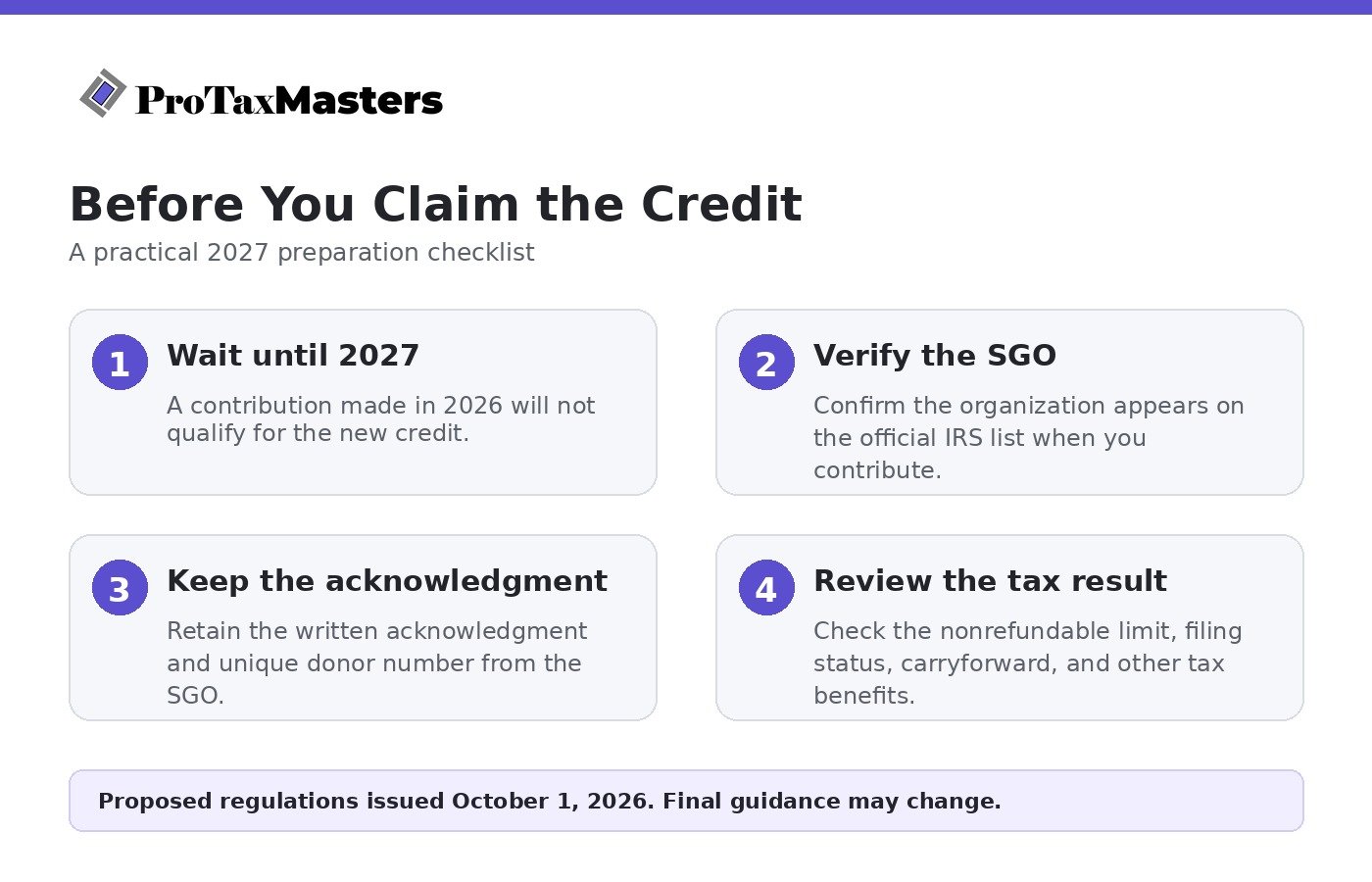
The program does not require an immediate contribution. For now, taxpayers considering the credit can take several measured steps:
- Wait until 2027. A 2026 contribution will not qualify for the 2027 credit.
- Use the official IRS list. Confirm that the organization is listed as an approved SGO at the time of the contribution.
- Review the tax effect. Consider federal tax liability, filing status, other charitable giving, and any applicable state credit.
- Keep the acknowledgment. Retain the SGO’s written acknowledgment and unique donor number.
- Watch for final guidance. The October 2026 regulations are proposed, and administrative details may change before taxpayers file returns claiming the credit.
Thoughtful Planning Matters
The new credit may offer Texas taxpayers a meaningful way to support educational opportunities beginning in 2027. It also introduces new eligibility, documentation, timing, and coordination rules.
Before contributing, verify the organization’s status and understand how the credit would apply to your individual tax situation. A contribution motivated by generosity should not be based on an assumed tax benefit that has not been confirmed.
ProTaxMasters LLC provides tax preparation and advisory services for individuals and families in San Marcos, Kyle, Buda, New Braunfels, Austin, San Antonio, and remotely. To discuss how a new tax provision may affect your planning, contact ProTaxMasters to schedule an initial consultation.
This article is for general educational purposes only and does not constitute individualized tax or legal advice. Proposed regulations and administrative procedures may change. Consult a qualified tax professional regarding your circumstances.