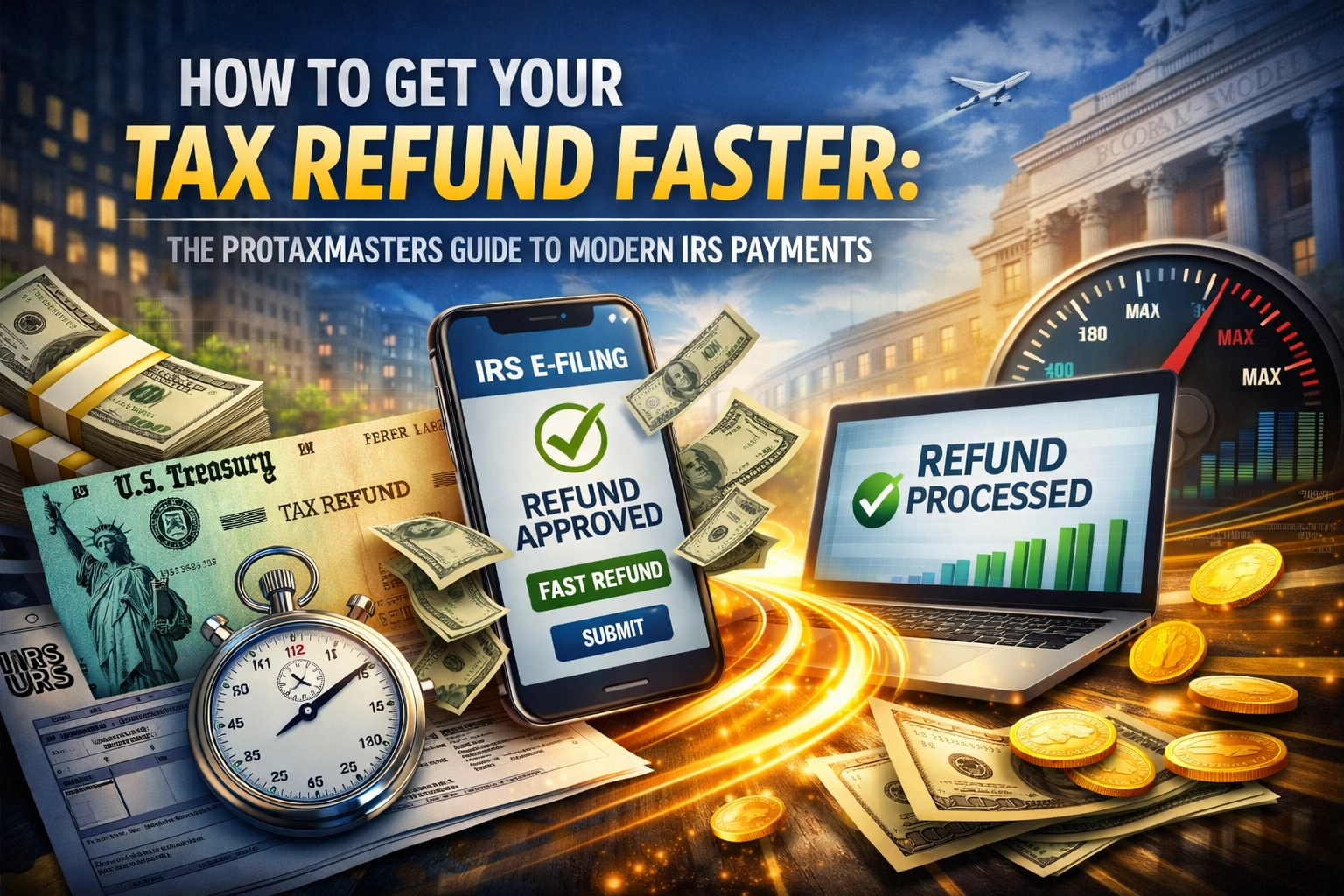
How to Get Your Tax Refund Faster: The ProTaxMasters Guide to Modern IRS Payments
There is nothing quite like the feeling of clicking "Submit" on your tax return and knowing that a refund is on its way. For many Americans, that refund isn't just a "bonus": it is a critical financial tool used to pay down high-interest debt, pad an emergency fund, or make a necessary household purchase.
However, the period between filing and seeing those funds hit your bank account can feel like an eternity. We all know how hard it can be to wait for your own money while inflation continues to nip at your heels. At ProTaxMasters, we want to ensure you aren't waiting a second longer than necessary.
As of today, Sunday, March 22, 2026, we are right in the thick of the filing season. The March 16th deadline for S-Corps and Partnerships has just passed, and the April 15th deadline for individual filers is looming large on the horizon. If you haven't filed yet, or if you are wondering where your money is, this guide will walk you through the modern IRS payment landscape and how to accelerate your refund.
The "Golden Rule" of Speed: E-File + Direct Deposit
If you take nothing else away from this guide, remember this: paper returns are the enemy of speed. In the modern era of tax administration, the IRS has streamlined its digital pipelines. When you file a paper return, you are essentially putting your refund on a slow boat. It has to be physically delivered, opened, sorted, and manually entered into the system by an IRS employee. This process can take six to eight weeks: or significantly longer if there are staffing shortages.
To get your refund in the fastest time possible (usually within 21 days), you must follow the two-step "Golden Rule":
- File Electronically (E-file): This allows the IRS computers to instantly receive and begin processing your data.
- Choose Direct Deposit: This eliminates the time it takes to print a check, mail it, and for you to manually deposit it at your bank.

Why Direct Deposit is the Gold Standard
Direct deposit isn't just about speed; it is about security. Every year, thousands of paper checks are lost in the mail, stolen from mailboxes, or returned to the IRS as "undeliverable" due to address changes.
When you opt for direct deposit, you can even split your refund across up to three different accounts. This is a fantastic way to automate your savings. For example, you could send 75% to your checking account for immediate needs and 25% directly into a high-yield savings account or an IRA.
To set this up, you will need:
- Your bank’s 9-digit routing number.
- Your account number.
- The type of account (Checking or Savings).
Errors in these numbers are one of the leading causes of refund delays. If the numbers don't match, the bank will reject the deposit, and the IRS will have to revert to mailing you a paper check, adding weeks to your timeline.
Technical Milestones: Understanding the PATH Act and 2026 Dates
It is important to understand that the IRS is legally bound by certain timelines that even e-filing cannot bypass. One of the most significant is the Protecting Americans from Tax Hikes (PATH) Act.
Under the PATH Act, the IRS cannot issue refunds for returns claiming the Earned Income Tax Credit (EITC) or the Additional Child Tax Credit (ACTC) before mid-February. This law was designed to give the IRS more time to verify income and prevent identity theft and fraud.
For the 2026 season, most taxpayers who claimed these credits and filed early saw their refunds hit bank accounts around March 2, 2026. Since we are now past that date, if you claim these credits and file today, your return will be processed in the standard 21-day window, provided there are no errors.
Key Deadlines to Remember:
- January 26, 2026: IRS began accepting individual returns.
- March 16, 2026: Deadline for Partnerships (Form 1065) and S-Corps (Form 1120-S).
- April 15, 2026: Deadline for Individual Tax Returns (Form 1040) and C-Corps (Form 1120).
- October 15, 2026: Deadline for those who requested an extension.
If you are a business owner who missed the March 16th deadline, it is imperative to file as soon as possible to minimize late-filing penalties. You can view our pricing-2026 page to see how we can help you get back on track.

Proactive Steps to Avoid IRS Delays
The IRS "Where’s My Refund?" tool is a great resource, but the best way to use it is to make sure you never have to worry about a "Pending" status for too long. We all know how hard it can be to see that "Your return is still being processed" message day after day.
To avoid the "dreaded delay," follow these preparation tips:
1. Gather All Information Documents
Before you even open a tax software or meet with us, ensure you have every W-2, 1099 (1099-NEC, 1099-MISC, 1099-K, 1099-INT), and 1098 in hand. Discrepancies between what you report and what the IRS has in their system (via copies sent by your employers/banks) will trigger an automatic freeze on your refund for manual review.
2. Check Your 1099-K
With the evolving rules regarding third-party payment processors like Venmo, PayPal, and CashApp, the 1099-K is more important than ever. Ensure that personal gifts or reimbursements aren't being incorrectly reported as business income. Correcting this before you file is much faster than responding to an IRS notice later.
3. Verify Social Security Numbers
It sounds simple, but misspelled names or transposed digits in Social Security Numbers for dependents are incredibly common. These errors result in immediate rejection or significant delays.
4. Report "Gig Economy" Income Accurately
If you did freelance work in 2025, ensure you are reporting all income. The IRS’s automated matching systems are highly efficient at spotting missing side-hustle income. If you're unsure how to categorize this, check out our tax-bookkeeping-insights for more detailed breakdowns.
Tracking Your Refund: Tools of the Trade
Once you have e-filed, the waiting game begins. The IRS provides several modern tools to keep you informed:
- Where’s My Refund?: Available on IRS.gov, this tool usually provides an update 24 hours after e-filing a current-year return. It has three stages: Return Received, Refund Approved, and Refund Sent.
- IRS2Go App: This is the official mobile app of the IRS. It provides the same information as the web tool but is optimized for your smartphone.
- Online Account: We highly recommend creating an "IRS Online Account." This allows you to view your tax records, see your payout history, and check for any notices the IRS might have sent you via mail that you haven't received yet.

What If Your Refund Is Lower Than Expected?
Sometimes, the "Refund Sent" amount doesn't match what was on your tax return. This is often due to "Refund Offsets." The Bureau of the Fiscal Service (BFS) can reduce your refund to pay off:
- Past-due federal tax.
- Past-due child support.
- Federal agency non-tax debts (like student loans).
- State income tax obligations.
If this happens, you will receive a notice in the mail explaining the offset. While this is frustrating, knowing why it happened helps you plan your finances more accurately for the rest of the year.
Why Professional Filing Makes a Difference
While many people attempt to DIY their taxes, the complexities of the 2026 tax code mean that a single missed deduction or a poorly formatted form can lead to a delay. At ProTaxMasters, we use professional-grade software that performs hundreds of diagnostic checks to ensure your return is "clean" before it ever hits the IRS servers.
If you’re feeling overwhelmed by the paperwork, you are not alone. We all know how hard it can be to balance running a business or managing a household while trying to be a tax expert on the side.
For those ready to get started, we recommend looking at your-quick-start-guide-to-tax-preparation-services-do-this-first-before-the-deadline. This guide will help you organize your documents so we can get your return filed and your refund processed in record time.
Final Checklist for a Faster Refund
To summarize, here is your action plan for the final weeks of the 2026 tax season:
- Go Digital: Forget the paper and stamps. E-file everything.
- Verify Routing/Account Numbers: Double-check, then triple-check.
- File Early: The closer we get to April 15th, the more "clogged" the IRS processing systems become. Filing now, on March 22nd, puts you ahead of the final rush.
- Use Modern Tracking: Download the IRS2Go app to stay updated.
- Consult a Pro: If your tax situation involves K-1s, rental properties, or crypto assets, professional oversight is the best way to avoid the "manual review" pile at the IRS.

The goal isn't just to file your taxes: it's to get your money back into your hands where it belongs. By utilizing direct deposit, e-filing, and the expertise of ProTaxMasters, you can navigate this tax season with confidence and speed.
Don't wait until the April 15th deadline is staring you in the face. Let's get your refund moving today!
<LEGAL_DOCUMENT:77bbf991-606a-4b5c-9eb7-9305300c20b4>