
October 15 Tax Extension Deadline: What You Need to Know Before You File
If you requested an extension to file your 2025 federal income tax return, the October 15 tax extension deadline is approaching.
The extra time can be valuable, but an extension does not change everything about your tax obligations. In particular, an extension gives most individual taxpayers additional time to file their return—it does not provide additional time to pay tax that was due earlier in the year.
With a few weeks remaining before October 15, now is a good time to gather missing documents, verify payments, resolve unanswered tax questions, and prepare an accurate return rather than waiting until the final days before the deadline.
What Is the October 15 Tax Extension Deadline?
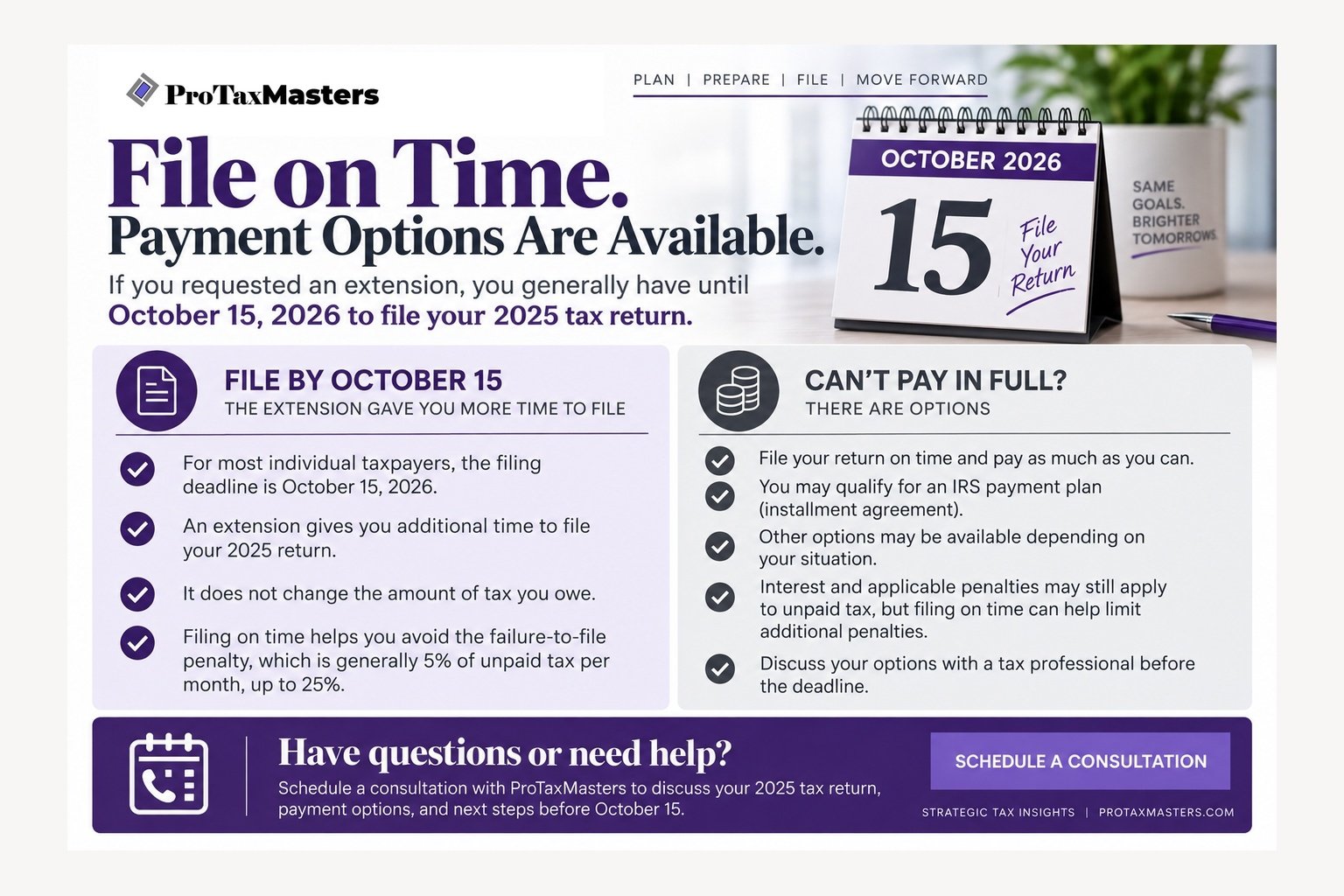
For most calendar-year individual taxpayers who timely requested a six-month extension, October 15, 2026, is the deadline to file the 2025 federal income tax return.
The extension generally moves the filing deadline from April 15 to October 15. It does not give taxpayers an additional six months to pay their 2025 federal income tax.
That distinction matters.
An Extension to File Does Not Mean an Extension to Pay
If you owed federal income tax for 2025, the payment was generally due April 15, 2026, even if you obtained an extension to file your return.
Interest generally accrues on unpaid tax from the original payment deadline, and applicable late-payment penalties may also apply.
If you made a payment when requesting your extension or made estimated tax payments during the year, those payments should be accounted for when your return is prepared.
Before filing, make sure your tax professional knows about all payments you made toward your 2025 tax liability.
What Should Extension Filers Be Doing Now?
An extension provides extra preparation time. Using that time effectively can make the filing process easier and help reduce the risk of filing an incomplete return.
1. Gather Missing Tax Documents
Review the information you already have and identify anything that may still be missing.
- Forms W-2 and 1099
- Schedule K-1s
- Brokerage and investment statements
- Retirement distribution information
- Business income and expense records
- Rental-property records
- Records supporting deductions or credits
- Estimated tax and extension payment confirmations
If you are unsure whether you received all required tax documents, address that question now rather than discovering the problem immediately before the deadline.
2. Review Income and Deductions for Completeness
A filing extension is not a reason to rush through the return once October arrives.
Review your income sources, deductions, credits, business activity, investments, and other significant tax items for the year. Taxpayers with multiple income sources or business interests may have information coming from several different places.
The goal should be an accurate and complete return, not simply a return filed before midnight on October 15.
3. Confirm Estimated Tax and Extension Payments
Keep records of payments made to the IRS during the year, including estimated tax payments and any payment submitted with an extension request.
Confirming those payments before filing can help prevent discrepancies between the return and IRS records. Taxpayers can also use their IRS Online Account to review certain account information and payment activity.
4. Resolve Unanswered Tax Issues
If something about your return remains uncertain, address it before filing.
Examples might include questions involving business versus personal expenses, basis in a business or investment, sales of property, rental activity, digital asset transactions, retirement distributions, prior-year tax issues, or missing and corrected tax documents.
Some questions require additional documentation or research. Waiting until the final days before October 15 can reduce the time available to resolve them properly.
What If You Owe Tax and Cannot Pay in Full?
Do not assume that you should delay filing simply because you cannot pay the entire balance.
The IRS advises taxpayers who cannot pay in full to file their return on time and pay as much as they can. Depending on the circumstances, taxpayers may qualify for an IRS payment plan or another collection alternative.
Filing and payment are separate issues. Failing to file a required return can create an additional penalty on top of interest and potential penalties associated with an unpaid balance.
If you expect to owe and cannot pay the full amount, understanding your options before the October 15 tax extension deadline can help you make a more informed decision about the next step.
What Happens If You Miss the October 15 Deadline?
For a taxpayer whose valid extension expires October 15, filing after that date can result in a failure-to-file penalty when tax is owed.
The IRS states that the failure-to-file penalty is generally 5% of the unpaid tax for each month or part of a month the return is late, up to 25%, although additional rules and exceptions can affect the calculation. See the IRS failure-to-file penalty guidance.
That makes filing the return particularly important even when a taxpayer cannot immediately pay the full balance.
Certain taxpayers may have different deadlines because of federally declared disaster relief, international filing rules, military service, or other special circumstances. Those situations should be evaluated individually rather than assuming October 15 applies in every case.
Why Filing an Accurate Return Matters
An extension gives you something valuable: time.
Use it wisely.
Filing an incomplete return simply to meet the deadline can lead to amended returns, IRS correspondence, processing delays, and other complications.
If your 2025 tax situation involved a business, investments, rental property, major life changes, multiple income sources, or unresolved prior-year tax matters, consider addressing those issues before the deadline rather than treating October 15 as the day to begin.

Need Help Before the October 15 Tax Extension Deadline?
If your 2025 return is still unfinished, now is the time to get organized.
ProTaxMasters LLC can assist with individual tax preparation, tax advisory matters, and IRS representation when tax problems extend beyond preparing the return.
Michael J. Garcia, EA, is federally authorized to represent taxpayers before the Internal Revenue Service.
Starting before the deadline provides more time to identify missing information, address tax questions, and prepare an accurate return.
Schedule a consultation with ProTaxMasters to discuss your 2025 tax return, payment concerns, or other tax issues before October 15.
This article provides general educational information and is not individualized tax, legal, accounting, or financial advice. Tax laws, IRS procedures, deadlines, and individual circumstances can vary. Consult a qualified tax professional regarding your specific situation.