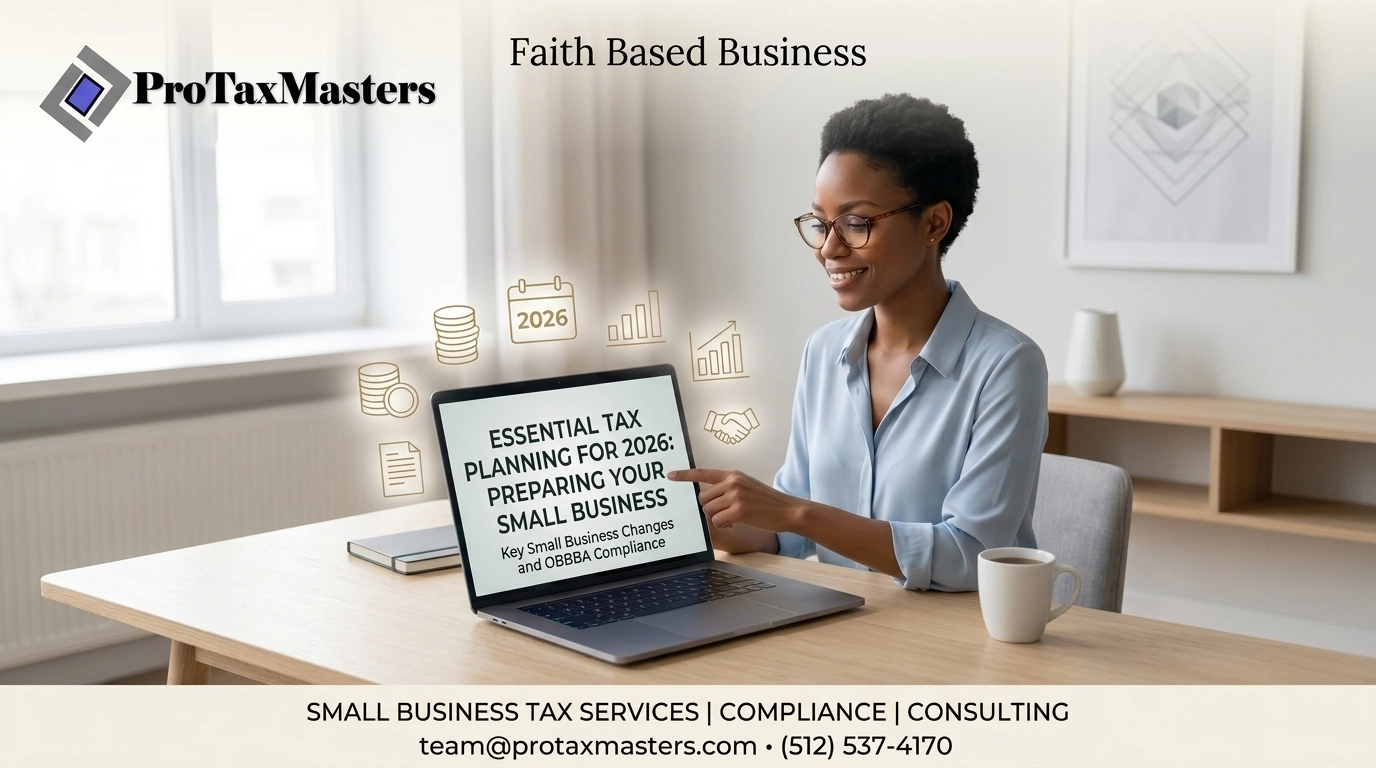
Tax Planning for Small Business: A Quick Guide to 2026 Business Tax Filing Changes Under OBBBA
The American tax landscape has shifted dramatically, making tax planning for small business owners more urgent than ever. On July 4, 2025, the "One Big Beautiful Bill Act" (OBBBA) was signed into law, effectively rewriting the playbook for small business owners and independent contractors. While the legislation was passed last year, the most significant provisions officially took effect on January 1, 2026, which means businesses now face immediate business tax filing and compliance decisions.
At ProTaxMasters, we know that tax law changes can feel like a moving target. However, the OBBBA is unique because it provides long-term certainty for several deductions that were previously scheduled to expire, while also creating new reporting, payroll, and planning responsibilities that should not be delayed.
This guide breaks down the major shifts in the 2026 tax code, specifically designed for small-to-medium businesses (SMBs), so you can strengthen your tax planning for small business operations and prepare for 2026 business tax filing with confidence.
1. The QBI Deduction is Now Permanent (Section 199A)
For years, small business owners operating as "pass-through" entities: such as sole proprietorships, partnerships, and S-corporations: worried about the expiration of the 20% Qualified Business Income (QBI) deduction. Under the OBBBA, this deduction is now a permanent fixture of the tax code.
What has changed?
Beyond making the deduction permanent, the 2026 overhaul expanded eligibility for higher-earning business owners. Previously, complex "phase-out" rules and W-2 wage limits made this deduction difficult to claim for high-earning service-based businesses (like doctors or consultants). Those thresholds have been relaxed, allowing more profitable firms to keep a larger share of their earnings.
The "Gig Economy" Minimum
A significant addition for the 2026 tax year is a new $400 minimum deduction. Any individual earning at least $1,000 in qualified business income is automatically entitled to a $400 deduction, regardless of whether their actual expenses justify it. This is a massive win for side-hustlers and the gig economy, effectively simplifying the filing process for those who might otherwise struggle with the "hobby vs. business" distinction.

2. Tax Planning for Small Business: Section 179 and Bonus Depreciation
If your business needs to invest in equipment, technology, or machinery, 2026 is the year to do it. The OBBBA significantly ramped up the incentives for capital expenditures.
Section 179 Doubled
The Section 179 expensing limit has been doubled. For the 2026 tax year, small businesses can immediately deduct up to $2.5 million for qualifying equipment purchases (adjusted for inflation). This allows you to write off the entire cost of equipment in the year of purchase rather than depreciating it over several years.
100% Bonus Depreciation
For the first time in years, the gradual "phase-down" of bonus depreciation has been reversed. Bonus depreciation is now restored to 100% and made permanent. This applies to both new and used equipment with a useful life of 20 years or less.
While Section 179 is often better for smaller businesses with a total equipment investment under the phase-out threshold, the permanence of 100% bonus depreciation provides a fallback for larger investments that exceed the Section 179 cap.
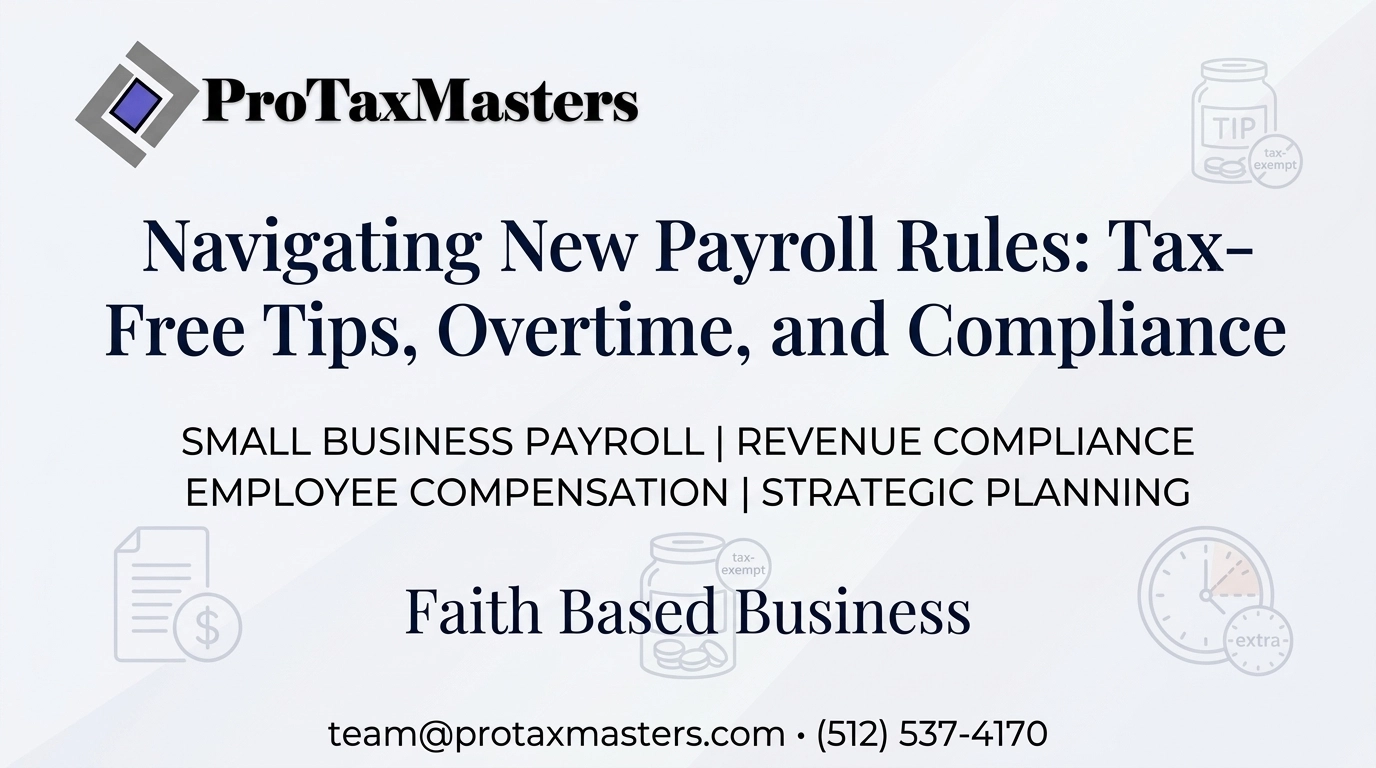
3. The New Payroll Paradigm: Tax-Free Tips and Overtime
Perhaps the most radical change in the 2026 overhaul concerns how employees are paid.
To combat labor shortages and incentivize productivity, the OBBBA introduced two brand-new provisions:
- Tax-Free Tips: Employees in service industries no longer pay federal income tax on tipped income.
- Tax-Free Overtime: For employees working more than 40 hours per week, the "overtime premium" (the amount paid above their standard hourly rate) is now exempt from federal income tax.
Employer Note: While these are massive wins for employees, they require a significant update to your payroll systems. Employers must ensure their software is configured to segregate standard wages from tax-exempt overtime and tips to ensure accurate reporting on Form 941. If you haven't updated your payroll protocols yet, ProTaxMasters can help you navigate these compliance requirements.
4. Enhanced Employer-Provided Childcare Credits
Attracting and retaining talent remains a top priority for SMBs. The 2026 tax law provides a powerful tool to help: the Employer-Provided Childcare Credit.
- The Standard Credit: For most corporations, the credit for childcare costs has increased to 40% (up from 25%), with a $500,000 annual limit.
- The SMB Advantage: Businesses that meet the "Small Business" definition under the act receive an even better rate: a 50% credit for childcare costs, capped at $600,000 annually.
This credit applies to building or renovating a childcare facility, operating a facility, or contracting with a third-party facility to provide spots for employees' children.
5. Technical Deadlines and Business Tax Filing Requirements for 2026
Despite the tax relief provided by the OBBBA, the IRS has signaled that documentation requirements will be more rigorous during this transition period. That makes business tax filing in 2026 especially time-sensitive for small business owners who want to protect deductions and avoid preventable penalties.
Missing a deadline can lead to steep penalties that wipe out the benefits of these new deductions, so early tax planning for small business compliance is critical.
Key Dates for Your Calendar:
- March 15, 2026: Deadline for S-Corporation (Form 1120-S) and Partnership (Form 1065) tax returns, or to file an extension.
- April 15, 2026: Deadline for Individual (Form 1040) and C-Corporation (Form 1120) returns. This is also the deadline for the first quarter estimated tax payment for 2026.
- June 15, 2026: Second quarter estimated tax payment deadline.
A Note on BOI Reporting
While the OBBBA changed many things, it is important to remember the state of FinCEN’s Beneficial Ownership Information (BOI) reporting. As of March 26, 2025, U.S. domestic companies and their owners were officially declared exempt from the previous BOI reporting requirements. You do not need to file a BOI report for the 2026 tax year.

6. The "Side Hustle" Trap: Business vs. Hobby
With the rise of the gig economy and rideshare platforms, the IRS is paying closer attention to whether your "side hustle" qualifies as a business or a hobby.
Under the 2026 rules, to qualify for the full suite of business deductions (like home office use and vehicle mileage), you must demonstrate a "profit motive."
If you are a rideshare driver, you should be tracking:
- Total miles driven (not just miles with a passenger).
- Parking fees and tolls.
- Pro-rated insurance and maintenance costs.
The $400 QBI minimum deduction mentioned earlier helps those in the "hobby" gray area, but if you want to maximize your returns, maintaining a separate bank account and rigorous records is essential.
How to Prepare Your Business
The 2026 tax law overhaul is designed to put money back into the hands of business owners, but the complexity of implementation cannot be overstated.
From adjusting payroll for tax-free overtime to maximizing the $2.5 million Section 179 limit, the strategy you choose now will dictate your year-end results. In other words, tax planning for small business owners cannot wait until the end of the year. The urgency of these 2026 changes means you should review your books, payroll setup, deduction strategy, and business tax filing deadlines now.
Next Steps for SMB Owners:
- Audit Your Payroll: Ensure your system can handle the new tax-exempt pay categories.
- Review Capital Plans: If you were planning on buying equipment in 2027, consider pulling those purchases forward into 2026 to take advantage of the permanent 100% bonus depreciation.
- Map Out Business Tax Filing Deadlines: Confirm your March 15, 2026, and April 15, 2026, filing or extension requirements now so you are not scrambling at the last minute.
- Consult a Professional: These laws are new, and the IRS guidance is still evolving.
At ProTaxMasters, we specialize in tax planning for small business clients navigating major legislative shifts. Whether you are a sole proprietor or managing a fleet of employees, our goal is to help you stay ahead of business tax filing requirements and ensure you don't leave a single dollar on the table.

Ready to take action? Visit protaxmasters.com, call (512) 537-4170, or email team@protaxmasters.com to schedule a consultation and get expert help with tax planning for small business needs and 2026 business tax filing.
Legal Disclaimer
IRS Circular 230 Disclosure: To ensure compliance with requirements imposed by the IRS, we inform you that any U.S. federal tax advice contained in this communication (including any attachments) is not intended or written to be used, and cannot be used, for the purpose of (i) avoiding penalties under the Internal Revenue Code or (ii) promoting, marketing, or recommending to another party any transaction or matter addressed herein.
FinCEN BOI Reporting: As of March 26, 2025, U.S. domestic companies and their owners are exempt from the requirement to file Beneficial Ownership Information (BOI) reports with FinCEN. Any previous guidance suggesting mandatory filing for these entities is superseded by this exemption.
Bonus Depreciation: Tax laws regarding bonus depreciation, including the restoration to 100% under the One Big Beautiful Bill Act (OBBBA), are subject to specific eligibility requirements and legislative changes. Business owners should consult with a tax professional to determine how these provisions apply to specific asset classes and acquisition dates.
No Professional-Client Relationship: The information provided in this blog post is for general informational purposes only and does not constitute professional accounting, tax, or legal advice. Accessing or viewing this content does not create a professional-client relationship between the reader and ProTaxMasters. You should consult with a qualified tax professional or accountant regarding your specific tax situation.