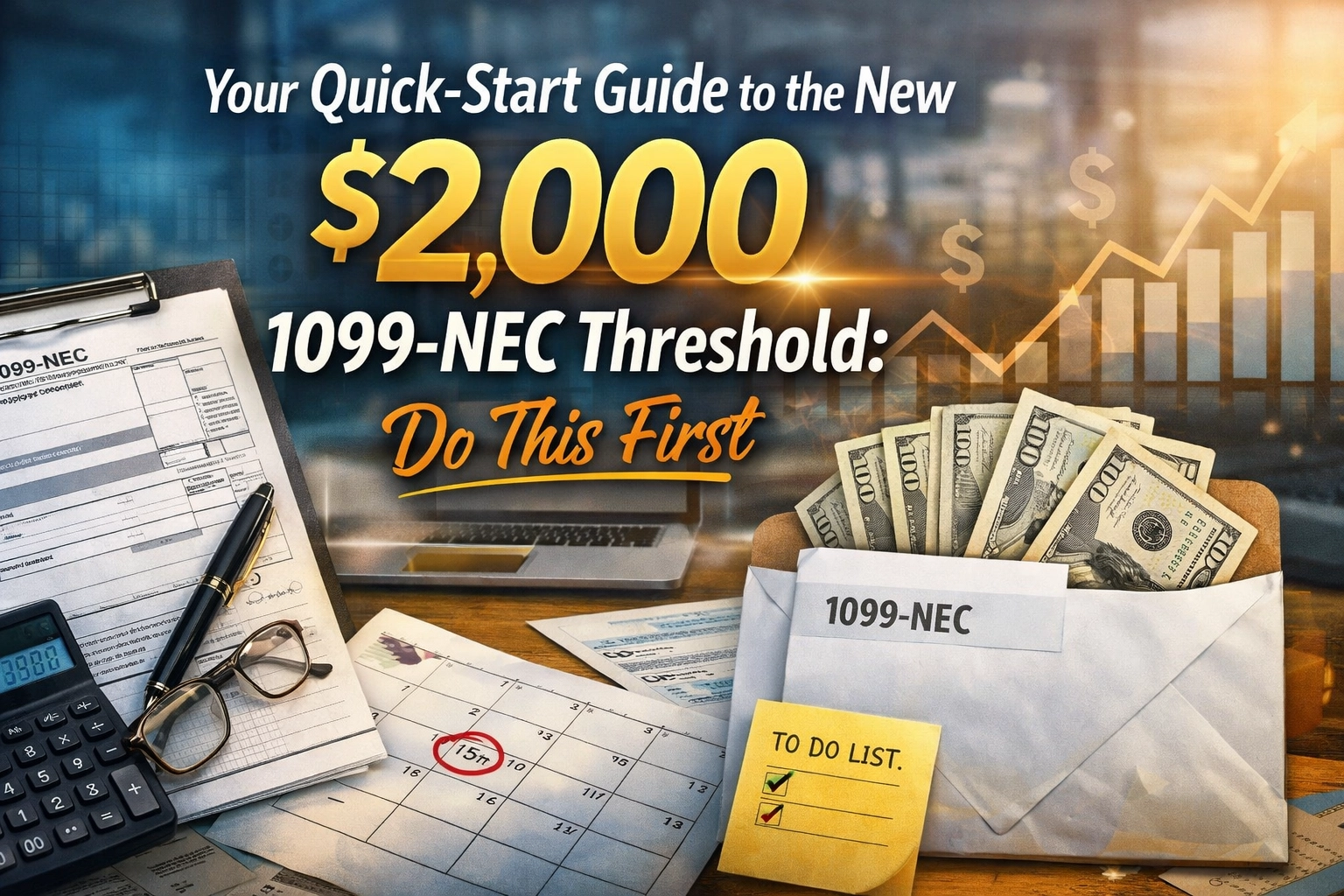
Your Quick-Start Guide to the New $2,000 1099-NEC Threshold: Do This First
It is Monday, March 23, 2026, and if you are a small business owner, you are likely in the middle of a caffeine-fueled sprint toward the April 15 tax deadline. While the March 15 deadline for S-Corps and Partnerships (Forms 1120-S and 1065) has just passed, there is a massive change on the horizon that is causing a lot of confusion in the back offices of San Marcos businesses.
For decades, the magic number for 1099 reporting was $600. If you paid a contractor more than that, you had to file a Form 1099-NEC. But the rules have shifted. Under recent legislative updates designed to account for inflation and administrative burden, the threshold for 1099-NEC and 1099-MISC is officially moving to $2,000.
However, before you stop tracking those smaller payments, there is a catch: The timing of this change matters more than the new number itself. At ProTaxMasters, we want to make sure you don't fall into a compliance trap. We all know how hard it can be to keep up with the IRS when they move the goalposts mid-game.
In this guide, we will break down exactly what this new threshold means for your 2025 filings (happening now) and how to set yourself up for success in the 2026 tax year.
The Most Important Distinction: 2025 vs. 2026
The biggest point of confusion right now is which year the $2,000 threshold actually applies to.
- For the 2025 Tax Year (The taxes you are filing right now in March/April 2026): You must still use the $600 threshold. If you paid a non-employee $600 or more during the 2025 calendar year, you are still legally required to issue a 1099-NEC.
- For the 2026 Tax Year (The payments you are making today): The new $2,000 threshold applies to payments made throughout the 2026 calendar year. You will first report based on this higher limit when you file your taxes in early 2027.
If you mistakenly apply the $2,000 limit to your current 2025 filings, you could face significant penalties for failure to file information returns. We all know how hard it can be to deal with IRS notices, so let’s make sure we get the current filings right first.

Why the Threshold Changed: A Technical Look
The $600 threshold had been in place since 1954. If that number had kept up with inflation, it would be well over $6,000 today. The jump to $2,000 is a compromise aimed at reducing the paperwork burden for small businesses and the IRS alike.
Specifically, this change applies to:
- Form 1099-NEC: Used for Non-Employee Compensation (independent contractors, freelancers, attorneys).
- Form 1099-MISC: Used for rent, royalties, and other miscellaneous income.
It is important to note that other forms remain unchanged. For example, the threshold for Form 1099-INT (Interest Income) and Form 1099-DIV (Dividends) remains at $10. If you are curious about how these specific forms impact your bottom line, you can check our pricing for 2026 services to see how we handle high-volume information return filing.
5 Critical Steps to Take Right Now
Even though the threshold for 2026 has increased, your internal processes shouldn't necessarily "relax." In fact, a higher threshold requires more diligent tracking to ensure you don't miss the cutoff. Here is your quick-start action plan.
1. Continue Collecting W-9s for Everyone
This is the most common mistake business owners make. They think, "I'm only going to pay this guy $1,200 this year, so I don't need a W-9."
Plans change. A small $500 project in April can easily turn into a $2,500 project by November. If you haven't collected a Form W-9 at the start of the relationship, you will find yourself chasing down contractors in January when they have no incentive to help you. Do this first: Make it a company policy to never issue a payment: regardless of the amount: until a completed W-9 is on file.
2. Monitor Cumulative Payments Carefully
The $2,000 threshold is per contractor, per year. If you use a bookkeeping system like QuickBooks or Xero, ensure your "1099 tracking" feature is updated for the 2026 fiscal year. We all know how hard it can be to go back through bank statements at the end of the year to tally up dozens of Venmo or Zelle payments. If you need help setting up these tracking systems, our team at ProTaxMasters can assist in streamlining your ledger.
3. Verify Your Vendor Classifications
The IRS is currently cracking down on worker misclassification. Just because the reporting threshold is higher doesn't mean the rules for "Independent Contractor vs. Employee" have changed. If the IRS determines that a person you paid $1,900 (under the reporting limit) was actually an employee, you could be liable for unpaid payroll taxes, unemployment insurance, and workers' comp.
4. Check Your State’s Requirements
This is a major technical "gotcha." The $2,000 threshold is a Federal change. Many states, including some with aggressive tax departments, may choose to keep their reporting threshold at $600. If your state requires a copy of the 1099-NEC for any payment over $600, you will still need to generate the form for state compliance, even if the IRS doesn't technically require it for federal purposes.

5. Adjust for Backup Withholding
Under IRS Section 3406, if a contractor fails to provide a correct Taxpayer Identification Number (TIN), you are required to perform "backup withholding" at a rate of 24%. Historically, this kicked in at the $600 mark. Moving forward into the 2026 tax year, the backup withholding requirement will also align with the new $2,000 threshold.
Key Deadlines to Remember for 2026
As we navigate this transition, keep these specific dates on your calendar to avoid late-filing penalties:
- January 31, 2027: Deadline to provide Form 1099-NEC to recipients and file with the IRS (for 2026 payments).
- February 28, 2027: Deadline to file paper Forms 1099-MISC with the IRS.
- March 31, 2027: Deadline to file electronic Forms 1099-MISC with the IRS.
- April 15, 2027: Individual and C-Corp tax returns due.
Remember, if you are an S-Corp or Partnership, your primary return deadline will always be March 15. Missing these dates can result in penalties ranging from $60 to $310 per form, depending on how late you file.

The "Inflation Factor" Starting in 2027
One of the most interesting parts of this new tax law is that the $2,000 limit isn't permanent. Starting in the 2027 tax year, this threshold will be adjusted annually for inflation. This means every December, business owners will need to check the new "magic number" for the upcoming year.
Keeping up with these annual fluctuations is a full-time job. We all know how hard it can be to stay profitable while also acting as your own Chief Tax Officer. This is why many local businesses rely on professional oversight. You can read some of our client testimonials to see how we’ve helped others navigate these shifting regulatory waters.
Summary Checklist: Your 2026 Prep
To recap, here is your "Do This First" list to handle the new threshold like a pro:
- Finish your 2025 filings using the old $600 rule (Deadline: Now!).
- Update your accounting software to flag 1099-NEC vendors at the $2,000 mark for 2026.
- Audit your W-9 folder to ensure every active contractor has a form on file.
- Confirm state-specific filing rules for the locations where you do business.
- Watch for the 2027 inflation adjustment announcement later this year.

A Note for San Marcos Gig Workers & Texas Freelancers
If you are a Texas freelancer or gig worker in San Marcos, this change can affect you in a very real, practical way—especially if you string together multiple smaller projects across the year (photography gigs around Texas State, delivery driving, event staffing, social media work for local businesses, handyman/maintenance jobs, or contract admin support).
Here are two quick reminders to keep you out of trouble:
- Clients may not issue a 1099-NEC if you are paid under $2,000 in 2026, but the income is still taxable. Even without a form, you are generally required to report self-employment income, and it may be subject to self-employment tax (Social Security and Medicare).
- Track your income and expenses all year. If you are picking up gigs around San Marcos and across Central Texas, keep clean records (invoicing, mileage logs, receipts, and payment confirmations from Venmo/Zelle/PayPal). Strong documentation helps you maximize legal deductions and makes filing far less stressful.
Don't Navigate the Changes Alone
Tax laws are becoming increasingly complex, even when they are "simplified" with higher thresholds. The interaction between federal limits, state requirements, and backup withholding rules creates a minefield for the unwary business owner.
If you are feeling overwhelmed by the 1099 transition or if you just want to make sure your 2025 filings are bulletproof before the April 15 deadline, we are here to help. At ProTaxMasters, we specialize in high-level tax planning and compliance for small businesses that want to grow without the fear of an audit.
Ready to get your 2026 tax strategy in order?
Let’s get your books in order so you can focus on what you do best( running your business!)
Professional Disclaimer
This article is for informational purposes only and is not intended as tax, legal, or accounting advice. Tax laws and regulations—including 1099 thresholds and BOI reporting requirements—are subject to frequent change. As of March 26, 2025, all entities created in the United States (domestic companies) and their beneficial owners are exempt from the requirement to report beneficial ownership information (BOI) to FinCEN. Only foreign-formed companies registered to do business in the United States remain subject to BOI reporting requirements. For the most current BOI guidance and filing details, visit fincen.gov/boi. This content is current as of the date of publication but may be superseded by new legislation, FinCEN guidance, or IRS updates.
Reading this article does not create a professional-client relationship. Because every situation is unique, you should not rely on this information without consulting a qualified professional. For guidance tailored to your specific facts and circumstances, please contact ProTaxMasters.